

Julie F Bacchini hosted this week’s PPCChat, welcoming Ginny Marvin to the conversation to answer Google Ads questions from PPC experts.
Q1 for Ginny:
It seems like to have your ads appear in the newer ad inventory (AI Overviews and AI Mode) advertisers need to have broad match enabled. And matching hierarchy is different for these ad positions – traditionally an exact match keyword would get preference over a broad. But with AI Overviews or Mode, the broad match keyword gets preference. So, what is on the roadmap for match types?
You will be eligible to have your ads appear in AI Overviews and AI Mode using Performance Max, Shopping and Search campaigns with broad match and/or AI Max for Search campaigns. To serve ads within AI Overviews, we consider both the user query and AI Overview content to understand the user intent more deeply. Since the ad is matched to both the user query and AI Overview content, only *broad match keywords or keywordless targeting* are eligible to trigger ads (even if there are exact match keywords present in the account). This is because we are not showing ads which are exactly matching the user query but for a deeper intent behind it. @adsliaison
And on keyword prioritization, when there are multiple keywords eligible to serve, the identical keyword/query combination is preferred, and within that exact is preferred over phrase/broad. For non-identical queries, we use AI based ad group prioritization to find the most relevant ad group. More information https://support.google.com/google-ads/answer/2756257?hl=en. @adsliaison
ok VERY brief (and promise my only) semi self promo, but highly recommend you watch Ginny + my bossman talk about “synthetic keywords” –https://www.optmyzr.com/ppc-town-hall/google-marketing-live-2025-exclusive-insider-intel-with-ginny-marvin/ or @PPCKirk‘s translation here – https://zatomarketing.com/blog/what-are-google-ads-synthetic-keywords @Aaronlevy
Aaronlevy Thanks for sharing. @adsliaison
thanks for being smart. @Aaronlevy
I try, but let’s not get ahead of ourselves @adsliaison
Q2 for Ginny:
I’d love to know how Google decides which clients can’t use a credit card as a payment method? We just set up a brand new account and before campaigns even launched, we got the alert requiring ACH payments.
This applies to a small segment of customers who receive differentiated support provided by our Large Customer Sales (LCS) team and Google Customer Solutions (GCS) High Touch Sales teams (more here https://support.google.com/google-ads/answer/6145574#11). Those on monthly invoicing have more options for billing support, growth is more easily accommodated via credit limit increases, and payment issues are less common due to longer billing cycles. @adsliaison
So is ACH required for only those clients? Or are we going to keep seeing it roll out for some of the “baby” accounts (small spenders who don’t have/qualify for dedicated support) @revaminkoff
This doesn’t seem to be how it actually works. I started a brand new account and got flagged for ACH before we even launched any campaigns. @Janinemonico
Can the support be forgone to maintain billing preferences? @Chriskostecki
Hi @Chriskostecki There is no action to take to opt out of or change an account’s segment designation. @Janinemonico I’ll see if there’s anything further to add, but that help center page above has more information. @adsliaison
Q3 for Ginny:
Why does [close variant] consistently match with competitor brands? What data does Google have that tells us these terms are likely to convert?
We see that users are often still in discovery and research mode when querying brand names. That said, we’ve also heard feedback and spoken with many advertisers who want better control over when/if their ads show on competitor terms. We introduced brand settings (brand inclusions and exclusions) to help address these concerns. More here: https://support.google.com/google-ads/answer/13721847?hl=en and do continue to share your feedback on this. @adsliaison
Is the general thought that people using exact match are looking to serve their ads to people in the research phase, especially those researching another brand? Do people in the research phase convert at a high enough rate to meet the target CPA these campaigns are often targeting? @Josephwilliams
Hi @Josephwilliams, The system sets bids based on predicted likelihood of conversion to help get as many conversions as possible at your target CPA, and keep your average CPA equal to your target CPA. @adsliaison
Can you answer the first part of the question as well, please? What data can you share that proves these matches aren’t just an attempt to squeeze money out of advertisers? The data I have, and many other PPCers have, is that these “matches” lead to wasted spend at best, and confused callers to businesses at worst. If Google didn’t match [close variant] in this way, do you think average CPL would go up? @Josephwilliams
Three types of keywords: Brand, NonBrand, and Competitor and all require unique strategies and messaging (not to mention budget, imo) @Chriskostecki
The predicted likelihood of conversion is what prompts the system to bid on those terms. Also just want to reiterate that we have heard this feedback and we’ve also heard feedback and had many conversations with advertisers about their expectations around these terms. That feedback was a big part of the impetus for introducing brand settings. @adsliaison
Is the general thought that people using exact match are looking to serve their ads to people in the research phase, especially those researching another brand? If Google didn’t match [close variant] in this way, do you think average CPL would go up? @Josephwilliams
Q4 for Ginny:
What’s the best match type to use while adding negative keywords – broad match negative, exact match negative or phrase? If it depends then where & how? How can we decide which is the best match type to use?
Ah, well it does indeed depend. But it’s a good question because negative keyword match types behave differently from positive match types. This article has a good overview, including examples, of how negative keywords and their match types work: https://support.google.com/google-ads/answer/2453972?hl=en @adsliaison
I’ve found this to be dependent on the nature of the (undesired) query string. For example, let’s say we want to avoid info-only queries. There is a case for adding the following (among many others):
- “how to”
- “how do”
- “how much”
- when
- who
- [brand name reviews]
There is a use case for each match type, so long as an advertiser is clear about how each functions. @teabeeshell
Is negative broad match matching as widely as positive broad match? / also becoming more signal based? @revaminkoff
@revaminkoff – Great Q, not sure, but curious for @adsliaison‘s take. @teabeeshell
I’ll throw it out there that single word negatives tend to be better on phrase match negative so you can easily import to Microsoft (this is how I managed accounts for years and tends to do a good job at blocking waste). @navahhopkins
Navah, same way I do it. Good to hear others do it this way too. @timmhalloran
Q5 for Ginny:
When will AI Max support be available in Ads Editor?
Very looking forward to this! @JuliaVyse
You’re in luck! AI Max is supported in Ads Editor, with version 2.10. More details here: https://support.google.com/google-ads/editor/answer/16320144 @adsliaison
Ginny got me a present this year! thanks so much, this is super helpful. @JuliaVyse
Q6 for Ginny:
How do Google ads and Google Local Services Ads work together? Or do they not? Why are the teams for this at Google completely separate and seem to pretend like the other side doesn’t exist?
Fast follow: will GMB be more supported in upcoming years? It directly impacts paid media and is janky as all get out. @JuliaVyse
If any of you know Anthony Higman, this question is his…@NeptuneMoon
They are distinct with different offerings for local businesses – and each works a little differently for different needs. Google Ads lets you target a broad audience and uses a pay-per-click model. Local Services Ads focuses on local leads with a pay-per-lead mode. Many local businesses use both platforms, but it really depends on their needs, market and goals. Local Services Ads has its own product team dedicated to building out features and functionality, though they also work closely with other Ads product teams. There are also dedicated support specialists for Local Services Ads given it functions differently.You can find a comparison of each platform here: https://business.google.com/us/resources/articles/small-business-marketing/ @adsliaison
@adsliaison this makes a lot of sense, thank you. For larger organizations that are likely to use both, is there a concern about both products bidding against one another in the same auction? @JuliaVyse
Q7 for Ginny:
Any POV from Google on SB 5814 in WA State in regards to digital advertising sales tax?
To comply with Washington state law, starting January 1, 2026, Google will begin collecting Washington sales tax on purchases of digital advertising services. Advertisers can submit exemptions, if applicable, in the Billing section of their accounts. Please note that Google cannot provide tax advice. @adsliaison
For everyone in this chat, Canada just went through a tax introduction and then removal in one year. Ask me anything. @JuliaVyse
Questions from Chatters
Q1: I’ve noticed that conversions from Demand Gen campaigns “vanish” within the attribution backfill time frame. (It feels like unstable ground.) What is the best way to approach reported conversions for this campaign type?
Just want to confirm one thing Demand gen doesn’t support portfolio bidding & also shared budget ? @Muhammadsaqib
I have some creatives doing well in term of conversion & ROAS in demand gen Now I want to push them more than others Is there anything I can do within the same ad group or I have to create different ad group with higher CPA ? Or any other way around ? @Muhammadsaqib
Why this always populating but still showing nothing although everything is okay ? Enhanced conversion is in place & also at account level conversion based customer list is opt in ? [Account Spending $10K+/month and this lists are showing this populating for almost an year ] @Muhammadsaqib
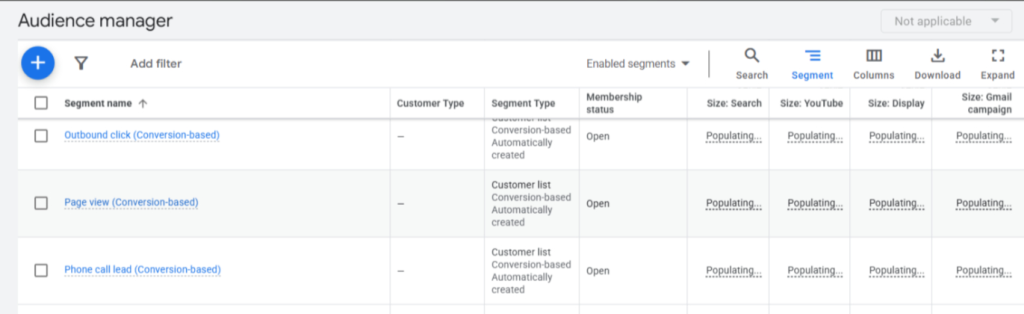
@NeptuneMoon can you add the above questions too? Sorry, posted in the wrong thread. Thanks @Muhammadsaqib
I will. If you have a follow up question to the question in the thread, then put it in that question’s thread. I’m also doing my best to capture everything in its right place! @NeptuneMoon
Q2: Is there a (self-serve) way for advertisers to tap into CTV-only placements via Google TV?
Q3: Are negative KWs the best way to steer query relevance for AI Max search campaigns?
Negative keywords can be one tool, but certainly not the best/only way to ensure your ads trigger for relevant queries. Ads, assets, landing pages are key relevancy levers. And so is your ad group structure. You want structures that help the AI understand the meaning of the keywords in the ad group and optimize accordingly. @adsliaison
Q4: Will there be an expansion of PMax asset reporting?
Right now it’s only for live campaigns and the lookback is only 90 days. My clients want to look at a full year of videos to understand what worked well and what needs improvement.
Q5: What is the future of search?
Great question. There is a lot happening in Search and this is a broad topic! You might find this recent podcast with Google’s Nick Fox insightful. https://www.youtube.com/watch?v=puEyEWlp13M @adsliaison
Q6: Is negative broad match matching as widely as positive broad match? Is it also becoming more signal based?
There’s no change in how negative keyword match types work. More info here: https://support.google.com/google-ads/answer/2453972?hl=en @adsliaison
Q7: What is your best advice at the moment for clients who want to make sure their budget is only going to specific products or use cases, but want to take advantage of AI search and some of these other more advanced features?
Looking at AI Max, it’s really designed to give you the flexibility and options to use the AI features you want and turn off those you don’t. While we recommend they all be used together, there are reasons to pick and choose. AI Max also have geo and brand controls available at the ad group level. Oh, and it has experiments support. And the basic fundamentals of focusing on relevant ads, landing pages, etc. doesn’t change with AI. @adsliaison
PPCChat Participants
- Ginny Marvin @adsliaison
- Aaron Levy @Aaronlevy
- Reva Minkoff @revaminkoff
- Janine Monico @Janinemonico
- Chris Kostecki @Chriskostecki
- Joseph Williams @Josephwilliams
- Travis @teabeeshell
- Navah Hopkins @navahhopkins
- Timothy Halloran @timmhalloran
- Julia Vyse @JuliaVyse
- Muhammad Saqib @Muhammadsaqib
- Julie F Bacchini @NeptuneMoon
Related Links
Stop the wasted ad spend. Get more conversions from the same ad budget.
Our customers save over $16 Million per year on Google and Amazon Ads.