

Today’s PPCChat focused on “Mistakes in PPC Accounts.” Host Julie F Bacchini invited experts to share the most common pitfalls they see when managing ad accounts, along with tricky platform nuances that are easy to overlook and much more.
Q1: What are common setup or structuring mistakes you see in ad accounts? Do you find different types of mistakes more often in different platforms or is it fairly consistent across platforms?
In setups, I find geographic settings are often leaky. And conversion actions that are either not setup right or are poor choices to designate as conversions (a.k.a. something for the platform to optimize toward). @NeptuneMoon
Auto targeting/placements enabled. @Chriskostecki
Yes, on the auto-applied anything @Chriskostecki ,especially because it is in more than one place on platforms these days! @NeptuneMoon
Yes, I exclude all foreign markets by practice across most networks, and it seems to cut out some traffic trying to mirror target locations. @Chriskostecki
Disclaimer: I work for Microsoft. Double-counting conversions. Too many ad groups for the budget. Average CPCs not aligned to the budget. Bid adjustments unintentionally driving up CPCs. Accidental duplicates. @navahhopkins
Ooohhh spread too thin with budget is a great one @navahhopkins What do you mean spending $400 across the entire country isn’t enough????? @NeptuneMoon
autocreated anything being enabled without people realizing it is a big one I’ve seen a lot of recently. Non-logical ad groups/asset groups/campaign structures – it should be clear to an outside observer/auditor what is where. Too many people still launch without conversion tracking in place correctly. @revaminkoff
Would naming conventions for campaigns fall under this too @revaminkoff because OMG the things I have seen…@NeptuneMoon
@NeptuneMoon 100%!! @revaminkoff
1. AARs accidentally turned on is a bit one. 2. Locations not set up correctly (people in vs. people looking for information about) 3. Bidding by ROAS or CPA with no amount set. 4. Tags not set up correctly (sometimes not counting conversions or $$$) 5. Having too many assets in a PMax campaign (yes, you can have too many) 6. Companies not creating videos for PMax 7. Just not doing video ads at all in this day and age…@lchasse
Location: Presence In & Interested In Auto Optimization – for creating site links & assets and auto applying recommendations. Obsessing over Optimization Score, Counting page views as conversions
Not passing values back and updating conversions. Not using customer list and lists from GA4
Not checking search terms and seeing only keywords. Not checking placements for pMaX..@alimehdimukadam
Oh and…
- Not turning off “auto-enhanced” assets in PMax
- Not turning off “expanded search” in PMax so they can target anything vs. what you want. @lchasse
“Interested In” should be autodefaulted to off for like… 99% of advertisers. @revaminkoff
For the dinosaur agencies who still believe ETAs are coming back, also not embracing the new stuff available because they don’t fundamentally believe in it. Literally had a brand talk about an agency who keeps arguing with them about the new stuff. I asked if they tested it and it failed or they just don’t like it for whatever reason. It was because they did not like it…@lchasse
Just got rid of some ETAs because I couldn’t edit them, but they were seriously outperforming the RSAs so…@revaminkoff
I’ve taken over some accounts recently that had a lot of keywords that were included in multiple campaigns/ad groups. And when keywords are segmented, there’s a lot of overlap in intent across ad groups/campaigns without any keyword exclusions to help traffic search terms to the relevant campaign/ad group. So you get the same search term triggering in multiple locations. @AnthonyMcDaniel
Conversion tracking setup/implementation is the first place I always look, and I find far too many issues (even in well-performing accounts). Lots of issues lately with auto-AI stuff. Meta turning on lots of enhancements, Google auto-applied recommendations, etc. @robert_brady
Sometimes, the way something is set up can give clues to how it was (mis)managed. Like in my previous example, it was pretty clear someone was just blanket applying keyword recommendations without much thought to how it would affect everything at a wider scale. @AnthonyMcDaniel
I have found that more often than not, control outperforms lack of control. It obviously makes sense for the platforms to move to lack of control, so they’ll make more money, but as advertisers, it’s important to monitor, test, and keep control where we can. @revaminkoff
The biggest, most unacceptable one is poor exclusions of branded terms (both company name and product names, if unique). Then campaigns labeled “Non-Brand” are a total mess, and performance will (have to) drop when an appropriate balance of Brand vs. Non-Brand is actually applied. @teabeeshell
Q2: What is something tricky on a platform that you now know is easy to miss or set up incorrectly without really realizing it?
Just happened earlier, Google UI allows demand gen brand campaign settings, AWE does not, need to remove from editor to publish changes, then re-add in UI. @Chriskostecki
Google and Facebook specifically (Microsoft is a little better about it) hide a lot of settings, whether it is location or asset optimizations. You really need to look for them and know to look for them to shut them off. Also, being super careful what you say to Google reps, because they will take anything you say as “you told me to turn on all AARs”. /sigh The reps will call clients directly and talk them into almost anything, so you have to be super careful about checking your accounts periodically so Mike from the mail room is not accidentally agreeing to turn on AARs, because a rep asked if he would want more exposure and revenue for his brand. @Ichasse
Soo many things- the two biggest are 1) “Presence and Interest in” in the geographic settings, which I think they still got rid of in a few places/is no longer a possible setting but really needs to be 2) the autocreated assets / AI Max features opt-in — both are really hidden and should be opted out of as default far more often than they’re opted into. @revaminkoff
Google might add their own images for location. It is in shared library under Locations. @NeptuneMoon
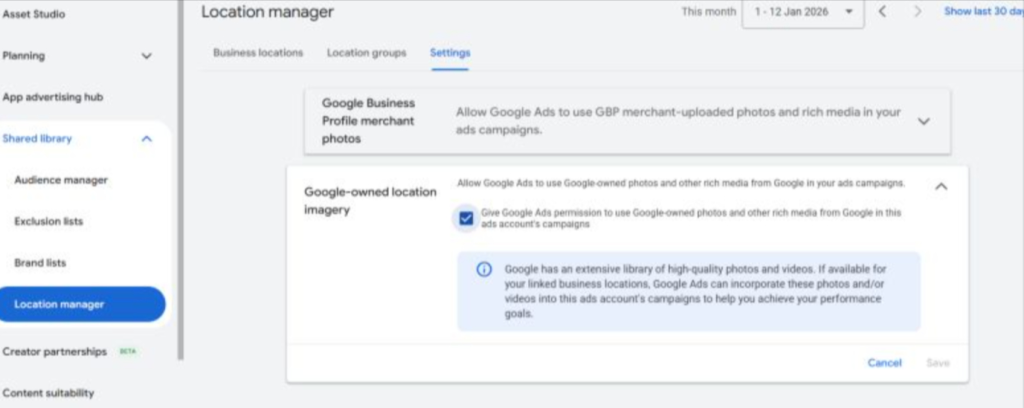
Following Default Options & Checks. @alimehdimukadam
I have stopped talking to the reps, problem solved. @Chriskostecki
There’s a bunch of stuff on Microsoft that you need to ask your rep to do for you/you can’t do yourself. @revaminkoff
@Chriskostecki I don’t talk to them either; however, if you won’t, they WILL call everyone on the account, whether they are CEOs, CMOs, accountants, etc, until they get someone on the phone since they are compensated by getting accounts to do certain things as part of their pay and bonus structure. @lchasse
I think the way that the optimization recommendations are worded can be really tricky, too in Google Ads. I had a client recently that enabled a pretty significant budget increase from that screen and had no idea she had done it. @NeptuneMoon
Please roast Microsoft if you have things to roast us on. if you love what we do, I, of course, want to hear it, but knowing what bothers you helps us get better. @revaminkoff, which things. @navahhopkins
@navahhopkins I want Microsoft to get clients more revenue than Google, so I can move more of my budget there! @lchasse
@navahhopkins I believe the opt-out of the audience network needs to be done by reps. @revaminkoff
Anytime you’re doing something in the interface, it often feels like I’m getting railroaded into using all the new features. And if you don’t want the shiny new toy, you have to 1) know that settings exist which can help and 2) where to find them. @robert_brady
@navahhopkins I would say generally that if a setting can be changed, it should be available as self-service. @NeptuneMoon
Honestly, you should never “need” a rep — SOOOO many more accounts don’t have reps than do have reps… (But right now, a rep is still a HUGE advantage everywhere) @revaminkoff
@revaminkoff I could not agree more. @NeptuneMoon
So what I’m hearing is that we need to clear pilots faster XD @navahhopkins
I think opting into the Display Network for search-only campaigns is a mistake, and yet an unfortunate default setting. @teabeeshell
Q3: What are common mistakes you see in the managing of ad accounts? (next question will be about mistakes we have made
Not adding negative keywords is still a massive one. Which honestly blows my mind. Over-testing or not waiting long enough when testing are big ones I see often too. @NeptuneMoon
Testing more than one thing at a time too. HOW DO YOU KNOW WHICH PART HAD THE IMPACT????????@NeptuneMoon
Quite a few, honestly. @lchasse
- Not verifying the accounts
- Not setting the EU (non-political ads policy stuff)
- Not using negatives enough or too much (yes you can have too many)
- Using broad match WAY too much
- Locations not being set
- AARs (again)
Checking search terms is the one that gets to me the most post keyword match type changes. The client or whoever managed the account sees keywords getting clicks that are aligned, but don’t drill down one step further. They’ll find the most random terms, competitor names, etc., all getting clicks. @alimehdimukadam
No one should be holding accounts hostage right now. @navahhopkins
Uploading lists if you don’t have a proper privacy policy in place allowing you to use the lists…@lchasse
Lack of control of a company’s own ad account is probably my #1 pet peeve – it’s mean, unethical, and avoidable. @revaminkoff
Anyone who uses the word “proprietary” when it comes to managing ad accounts and hides behind it @NeptuneMoon
If you’re using auto-generated or dynamic anything, you still need to check and make sure that those assets make sense! @revaminkoff
Sidebar for the old folks here – remember when people used to act like they could exclusively buy keywords for clients????? @NeptuneMoon
I know an agency owner who still says, “We use proprietary information, so we need to own the account”. I told him that was absolute malarkey, but he will go to his grave thinking that. I think it is pure evil to try and own another brand’s ad account. We work at their pleasure IMO, and let’s be honest, running ads is not rocket science (sorry to anyone who believes they are rocket scientists). @lchasse
It is even worse when they absolutely will NOT let that account pass to the business too. Especially now that advertiser verification is part of it. Extra evil. @NeptuneMoon
Broad match keywords with non-smart bidding strategy (Max Clicks) while there is minimum amount of conversions in the account. @SofiaAkritidou
Incomplete campaign build-out. I (almost) never see a reason to not include ALL headlines, long headlines, descriptions, images, videos, etc. The only exception might be lack of visual assets…for a brand new brand. @teabeeshell
Q4: What mistakes have you made in the managing of ad accounts (because we all have!)?
Let’s let the newer PPCers see that we have all made mistakes! @NeptuneMoon
Adding Georgia the country, not the state…@teabeeshell
I remember years ago there was a setting in Microsoft Ads (then Bing Ads) for geo targeting that was very confusing. I was entering in a bunch of zip codes and towns, and it asked “show ads in additional locations,” which I checked because I thought it mean that I could add more locations…Friends, it let the platform show ads all across the US for a local service business in the greater Philly area. @NeptuneMoon
Wrong geo… the worst is still the time when I forgot to add any geo targeting but the second worst is when “interested in” is accidentally still on and a lot of international traffic comes in…@revaminkoff
Good lord the list is long over my career, lol @lchasse
- entering the wrong codes for links
- missing the location settings when they changed initially
- accidentally forgetting to turn off “all other products” in a shopping feed when trying to advertise just certain products
- not selecting a group of products when setting up a PMax campaign so accidentally advertising everything instead of just the category
We have all put in an incorrect budget amount, I am sure. Those decimal points can really make a difference @NeptuneMoon
Budgets – there have been instances of overshooting & underutilizing. Not putting an end date for a time-bound campaign and manually switching it off 12 hours after. Giving in to clients to spend in spite of knowing it’s wasted spend and switching on phrase/broad match simply coz they had to consume the budget for the quarter. @alimehdimukadam
I have taken too long to change the budget at the beginning of the month before – which can then put you behind really fast. @revaminkoff
Sidebar: This is why any freelancer or agency should be carrying “errors and omissions” insurance to cover your tail. @lchasse
@lchasse Absolutely on the errors and omissions policies. @NeptuneMoon
I think I still often make a mistake in terms of budgets. My biggest mistake, I think, was following what client would tell me rather than pushing back based on what I believe/see in the account. @SofiaAkritidou
I should add the E&O insurance in the US is not that expensive and it could really save your bacon. @NeptuneMoon
I got it as soon as I went out on my own. Best peace of mind you can have. @lchasse
I had the good fortune to have a family friend who owned an agency sit me down and tell me all the stuff I needed to get straight to be doing business on my own when I started out. And I try to pay that forward by telling you all the same kind of stuff! Have any of you ever loaded up the wrong creatives????? Been there too. @NeptuneMoon
Yep. @lchasse
Forgot to put an end date on a promotion is one too. @NeptuneMoon
Easy not to make mistakes if you are just doing one or two campaigns, but when you have 20 to update with seasonal or big message changes, it can absolutely happen, especially working on your own without a second set of eyes on the campaigns/creative.@lchasse
No matter how careful you are or how long you have been doing this, mistakes can still happen. Having good practices in place to double-check things definitely helps. And regularly checking on things that can make for expensive mistakes is also a good practice to get into if you’re not. But the biggest thing if you do make a mistake is to own up to it, fix it and figure out how you will prevent repeating it. And share all that with client or stakeholders. @NeptuneMoon
99.9% of the time clients will get annoyed, but won’t come after you, but the insurance is for that 0.1% of the time a client goes off the rails on you. For budgets, use a dashboard tool (some cheap ones out there) so you have a daily dashboard, because yes, it can limit how big an impact your mistakes have. I think Swydo is the cheapest one out there currently, unless there is another someone knows about. @lchasse
For Google only – having a script for sending an email to you daily or weekly with budget pacing run in the MCC – completely free @alimehdimukadam
^and using your preferred LLM to help write the scripts is also next level clutch. @AnthonyMcDaniel
Q5: What are common mistakes you see clients making in the managing of ad accounts or in what they ask you to do?
One of the biggest mistakes I see clients making is having unrealistic ideas about their account’s performance potential. Like wanting some ROAS that will never happen or a CPA that is pure fantasy. @NeptuneMoon
Making site changes that affect tracking or performance without telling us first. @revaminkoff
I had client go into the account and auto-apply recommendations they see in UI. @SofiaAkritidou
Thinking that they should copy everything their competitors or some brand they like does in advertising.@NeptuneMoon
So frustrating when a client thinks that if a competitor did it ever than they have to do it too @revaminkoff
The one I dislike the most is when they start working on the account when you are responsible for their performance. @lchasse
I always tell them – you have no idea how/if that strategy is working, @NeptuneMoon
@NeptuneMoon I tell them that no two businesses are the same. you don’t know what the other business’s math it. @revaminkoff
Emailing you to say “I searched for few of the keywords and my ads are not showing!” @SofiaAkritidou
Oh, we have rules about who touches the account in the contract @lchasse for just that reason. @NeptuneMoon
In-account, I think having two “different” hands on the steering wheel is a mistake. Having only an insider/in-house employee (with outside guidance) or an outsider (agency/consultant) making changes is a must.
On-site, clients almost never think to alert downstream teams of changes made. It should be a default communication, but there seems to be this bizarre sense of relief of, “Yes, changes have been pushed live! All problems will be resolved/non-existent!” attitude that prevails. @teabeeshell
I do as well, but it is still theirs. I tell them I am not responsible for the results if you make changes in the account. So far, they always stop after I say that. @Ichasse
Ooohh how about not responding in a timely manner to leads that come in. And then being mad about the overall bottom line. Miss me with that please. @NeptuneMoon
Obsess over Optimization Score @alimehdimukadam
Misunderstanding who their customers actually are is a big one too. I worked on an account some years ago who swore up and down that their core customers were millennial women. I did not think that was true for a number of factors (including the price point of the product). So I asked for sales data where they had any demographic details. Millennial women did buy, but only during the semi-annual big sale events. GenX women bought much more consistently all year long. But they would not shift their messaging. @NeptuneMoon
@NeptuneMoon The concept of “knowing” your customer (demographics) died a long time ago… I also struggle with people who think they have it down to a science. Like, there are anomalies that make up a huge percentage of people who buy your product/service… Don’t sell yourselves short! @teabeeshell
I love the example of grandparents for baby things to make that case. Sure, parents are huge buyers, but so are their friends and families, particularly for babies. So ignoring the people who are not the new parents is silly. @NeptuneMoon
PPCChat Participants
- Julie F Bacchini @NeptuneMoon
- Reva Minkoff @revaminkoff
- Robert Brady @robert_brady
- Ali Mehdi Mukadam @alimehdimukadam
- Sofia Akritidou @SofiaAkritidou
- Chris Kostecki @Chriskostecki
- Navah Hopkins @navahhopkins
- Lawrence Chasse @Ichasse
- Travis @teabeeshell
- Anthony McDaniel @AnthonyMcDaniel
Related Links
Stop the wasted ad spend. Get more conversions from the same ad budget.
Our customers save over $16 Million per year on Google and Amazon Ads.