

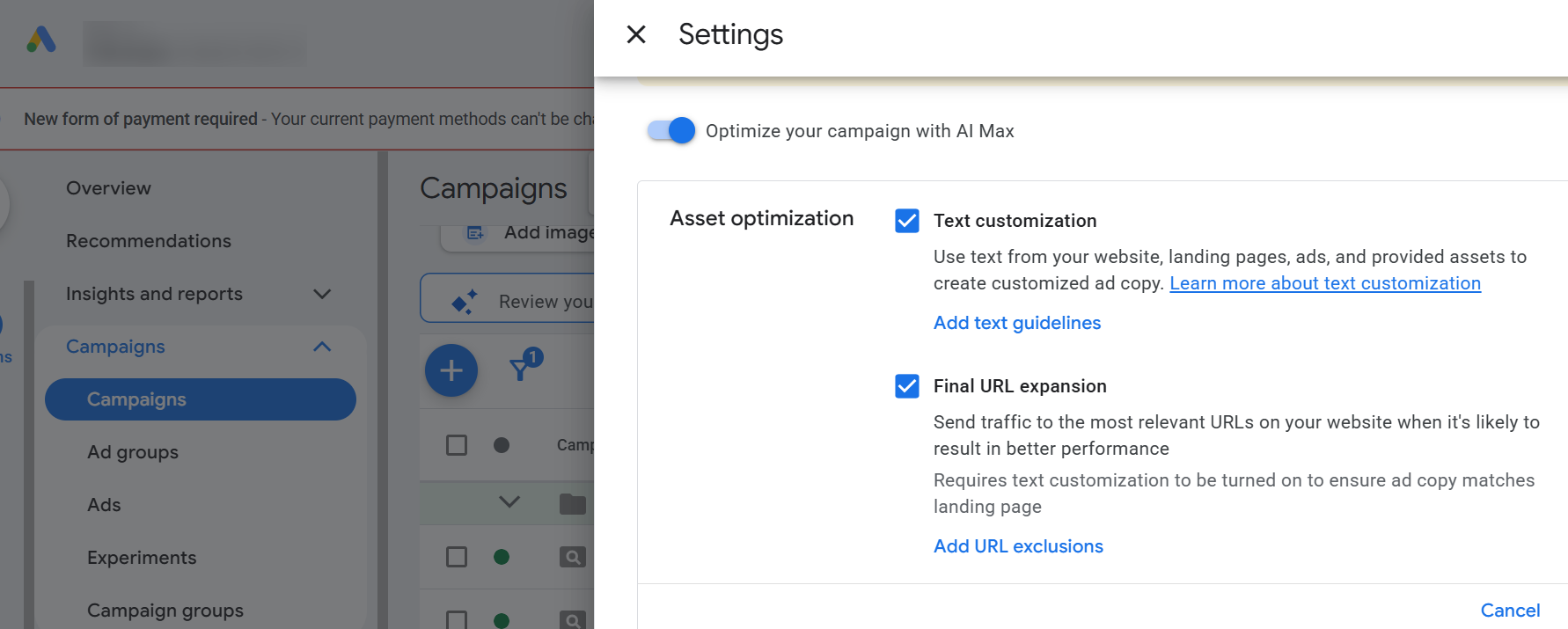
Google Ads continues to move toward more automated campaign creation and optimization. With AI Max for Search campaigns, advertisers get additional automation layers around targeting, creatives, landing pages, and query matching. One feature that deserves closer attention is Text Customization.
In this post, we’ll break down what Text Customization is, how it works inside AI Max for Search campaigns, where it helps, where advertisers should be cautious, and how to control it effectively.
TL;DR
AI Max for Search campaigns can dynamically customize ad copy using landing pages, search intent, existing assets, and AI-generated variations. This helps improve query relevance and scale creative testing, especially for broad match and long-tail searches.
However, advertisers should closely monitor:
- Landing page quality
- Automatically generated assets
- Search term relevance
- Compliance-sensitive messaging
- Brand consistency
Strong campaign structure, updated landing pages, negative keyword management, and regular asset reviews are essential for getting good results from Text Customization without losing creative control.
What Is Text Customization in AI Max?
Text Customization allows Google Ads to dynamically generate or adapt ad copy elements using:
- Existing ad assets
- Landing page content
- Search query context
- Headlines and descriptions from other assets
- Business and product information
- AI-generated combinations and variations
The goal is to improve relevance between:
- User search query
- Ad copy
- Landing page experience
Instead of relying only on manually written headlines and descriptions, AI Max may automatically create or modify messaging to better align with user intent.
This functionality is part of Google’s broader automation push where campaigns increasingly rely on AI-generated creative assets.
Why Google Introduced Text Customization?
Traditional Search campaigns required advertisers to manually:
- Create multiple ad variations
- Segment campaigns by intent
- Write query-specific messaging
- Continuously test ad copy
AI Max attempts to reduce this manual workload.
Google’s AI system tries to:
- Match messaging to intent automatically
- Improve CTR through higher relevance
- Scale creative testing faster
- Adapt ads to long-tail queries
- Reduce dependency on large keyword lists
For advertisers running large product catalogs or multiple service categories, this can reduce operational overhead.
Example of How Text Customization Works
Suppose an advertiser sells running shoes.
Advertiser’s Original Assets
- “Shop Premium Running Shoes”
- “Free Shipping Available”
- “Trusted Sports Brand”
User Search Queries
- “lightweight running shoes for marathon”
- “men’s cushioned running shoes”
- “best shoes for long distance running”
AI Max may dynamically create combinations like:
- “Lightweight Running Shoes for Marathon Training”
- “Cushioned Running Shoes for Long Distance Runs”
- “Shop Men’s Performance Running Shoes”
Some of these may be generated using landing page content or extracted product information.
Where Advertisers Should Be Careful While Using Text Customization?
Despite the benefits, Text Customization also introduces several risks.
1. Brand Messaging Drift
AI-generated messaging may not fully align with brand tone.
Examples:
- Overpromising language
- Excessive promotional wording
- Missing legal disclaimers
- Inconsistent terminology
- Messaging that sounds too generic
For regulated industries or premium brands, this can become a major concern.
2. Landing Page Dependency
If landing pages contain outdated, vague, or experimental content, AI Max may pull those elements into ads.
This means:
- Weak landing page copy can affect ads
- Temporary promotional text may appear unexpectedly
- SEO-oriented content may influence ad messaging
- Irrelevant sections may get emphasized
In many cases, advertisers overlook this connection.
3. Reduced Creative Control
Advertisers used to maintain tight control over:
- Headlines
- CTAs
- Brand language
- Value propositions
With Text Customization enabled, some of that control shifts to Google’s AI systems. This makes creative governance more important than before.
4. Compliance Risks
Industries like:
- Healthcare
- Finance
- Legal
- Supplements
- Insurance
- Education
may face compliance issues if AI-generated text introduces unsupported claims. Advertisers should carefully review automatically created assets.
Best Practices for Using Text Customization
1. Maintain Strong Landing Page Hygiene
Since AI Max can use landing page content for messaging generation:
- Keep headlines clear
- Remove outdated offers
- Avoid vague copy
- Structure pages properly
- Use consistent terminology
- Keep compliance messaging visible
Your landing page increasingly becomes a creative input source.
2. Review Automatically Created Assets Frequently
Inside Google Ads, regularly monitor:
- AI-generated headlines
- AI-generated descriptions
- Asset performance
- Messaging variations
Look for:
- Off-brand messaging
- Incorrect product references
- Misleading claims
- Repetitive phrasing
- Poor CTAs
This review process becomes critical in AI-led campaigns.
3. Use Strategic Text Assets
Even though AI generates combinations, advertiser-provided assets still influence outcomes.
Provide:
- Strong headlines
- Clear value propositions
- Query-aligned messaging
- Category-specific language
- High-quality descriptions
Weak manual assets often produce weaker AI combinations.
4. Segment Campaigns by Intent
AI Max performs better when campaigns maintain clearer intent structures.
For example:
Separate:
- Brand campaigns
- Generic campaigns
- Competitor campaigns
- Product-category campaigns
- High-intent service campaigns
This improves the quality of AI-generated messaging.
5. Watch Search Terms Closely
Text Customization becomes more powerful — and riskier — when broad matching expands query coverage.
That’s why reviewing the following becomes a crucial task:
- Search terms
- Triggered landing pages
- Generated messaging themes
- Query intent patterns
This helps identify:
- Irrelevant query expansion
- Mixed-intent traffic
- Messaging mismatches
- Poor-quality clicks
How Text Customization Connects With URL Expansion
Text Customization and URL Expansion often work together.
Example workflow:
- AI Max identifies a relevant query
- URL Expansion selects a landing page
- Text Customization extracts messaging from that page
- AI-generated assets adapt to the search intent
This means landing page quality now impacts:
- Final URL selection
- Ad messaging
- Search relevance
- Asset generation
Advertisers should think of these features as connected systems rather than isolated settings.
Should Advertisers Enable Text Customization?
The answer depends on campaign goals and brand requirements.
Text Customization May Work Well For:
- Large ecommerce catalogs
- Broad product inventories
- Scalable lead generation
- Long-tail query targeting
- Advertisers with strong landing pages
- Teams comfortable with automation
More Caution May Be Needed For:
- Regulated industries
- Strict compliance environments
- Premium/luxury branding
- Highly controlled messaging strategies
- Advertisers with inconsistent landing pages
In many cases, testing with limited campaigns first is the safest approach.
Recommended Testing Approach
Instead of enabling AI Max broadly across all campaigns:
Start With:
- One campaign
- Controlled budget
- Well-structured landing pages
- Strong negative keyword controls
- High-quality ad assets
Then Evaluate:
- CTR changes
- Conversion quality
- Search term relevance
- Generated asset quality
- Landing page selections
- CPA trends
This phased rollout helps identify where automation genuinely adds value.
Key Questions Advertisers Should Ask
Before enabling Text Customization, advertisers should evaluate whether their account structure, website content, and internal processes are ready for AI-generated messaging.
These questions are important because AI Max does not work in isolation. The system pulls signals from landing pages, search queries, existing assets, and campaign structures. Weaknesses in any of these areas can directly influence the quality of generated messaging.
- Are landing pages updated regularly? – This matters because AI Max may extract messaging directly from landing pages. So if a page contains expired offers, old pricing, outdated product information etc., then those details are most likely to appear in the ads.
- Is the site content clean and accurate? – AI systems rely heavily on website content quality. If content is vague, inconsistent, or overly generic, AI-generated messaging may become repeated, misaligned with customer intent.
- Are there compliance-sensitive claims? – This is especially important for industries where messaging is regulated. AI-generated messaging may unintentionally overstate benefits, introduce unsupported claims, avoid mentioning necessary disclaimers.
- Do campaigns have clear intent segmentation? – Campaign structure strongly affects AI-generated messaging quality. If campaigns mix very different intents together, AI Max may struggle to generate relevant messaging consistently.
- Are search terms monitored frequently? – Text Customization becomes more dynamic as query expansion increases. Without regular search term reviews, advertisers may miss irrelevant queries, low intent traffic, messaging mismatch which at the end results in budget wastage
- Is the team prepared to review generated assets? – Many advertisers underestimate the operational work involved with AI-generated creatives. If nobody reviews these assets regularly, campaigns may gradually drift away from the brand intent.
These operational factors matter more in AI-driven campaigns.
Final Thoughts
Text Customization in AI Max for Search campaigns represents another major step toward AI-generated advertising.
It can improve scalability and query relevance significantly, especially for advertisers managing large keyword sets or broad-match campaigns.
However, the feature also shifts more creative influence toward Google’s AI systems. Advertisers who maintain strong landing pages, clean campaign structures, and active search term monitoring are more likely to benefit from it.
The key is not to treat Text Customization as a “set and forget” feature.
Instead, advertisers should approach it as:
- An optimization layer
- A creative assistant
- A scalability tool
- A system that still requires oversight
The advertisers who balance automation with strong campaign governance will likely see the best results from AI Max.
FAQ
Does Text Customization replace Responsive Search Ads?
No. Responsive Search Ads still form the core ad format. Text Customization enhances or dynamically adapts messaging within the AI Max framework.
Can Google generate headlines automatically in AI Max?
Yes. Google may generate additional text assets using landing pages, business information, existing assets, and search query intent.
Is Text Customization the same as Automatically Created Assets?
They are closely related. Text Customization can use automatically generated assets as part of the ad experience.
Can advertisers disable automatically generated text?
Controls may vary depending on campaign configuration and feature rollout. Advertisers should review campaign settings and asset controls regularly.
Why should landing pages be monitored carefully?
Because AI Max may extract messaging directly from landing pages for ad generation and query alignment.
Does Text Customization affect search query targeting?
Indirectly, yes. As campaigns expand query coverage through automation and broad matching, dynamic messaging adapts to those queries.
Should advertisers use negative keywords with AI Max?
Absolutely. Negative keywords remain important for controlling irrelevant traffic and improving AI-generated query alignment.
Related Links:

Stop the wasted ad spend. Get more conversions from the same ad budget.
Our customers save over $16 Million per year on Google and Amazon Ads.