

Most PPC marketers know the two fundamental building blocks of a successful Google Ads campaign: keywords and negative keywords. Together, they improve targeting, reduce wasted ad spend, and help ensure your budget is spent on the clicks that matter most. But if they aren’t managed carefully, they can quickly clutter your account and make it harder to manage.
There’s a saying, “The more, the merrier,” and in the early days of Google Ads, that approach often worked. To build a successful account, advertisers would upload spreadsheets containing thousands of keywords, their variations, misspellings, and long-tail keywords, and organise them across numerous ad groups in an effort to capture as much search traffic as possible.
Today, PPC is a lot more complex. With AI-powered campaigns, increasingly flexible match types, and ongoing changes to negative keyword functionality, finding the right balance has become more important than ever.
Does Keyword Quantity Really Matter in Google Ads?
As Google Ads relies more on machine learning, advertisers no longer need to create separate keyword lists like before. However, managing keywords is still important because relevant keywords help campaigns perform better.
Too many keywords scattered across an account can lead to:
- Keyword cannibalisation
- optimisation difficulty
- increased management complexity
- difficulty in analysing performance
On the flip side, too few keywords means:
- limited reach
- less conversion opportunity
- missing valuable search intent
- restrict growth opportunity
The main focus is not on maximising or minimising the keyword count; it’s about achieving the right relevance.
Keywords vs Negative Keywords: Why We Need Them?
A strong PPC strategy relies on both Keywords and negative keywords. While keywords help you connect with people searching for your products or services, negative keywords help prevent your ads from appearing for irrelevant searches.
| Keywords | Negative Keywords |
|---|---|
| running shoes | jobs |
| accounting services | free |
| PPC management tools | discount |
| plumbing services near me | career |
| water heater repair | course |
A successful PPC account requires both growth and control. While keywords help increase visibility and reach the right audience, negative keywords improve efficiency by filtering out irrelevant traffic, creating the right balance between exposure and performance.
Google Ads Keyword Limits: How Many Can You Have?
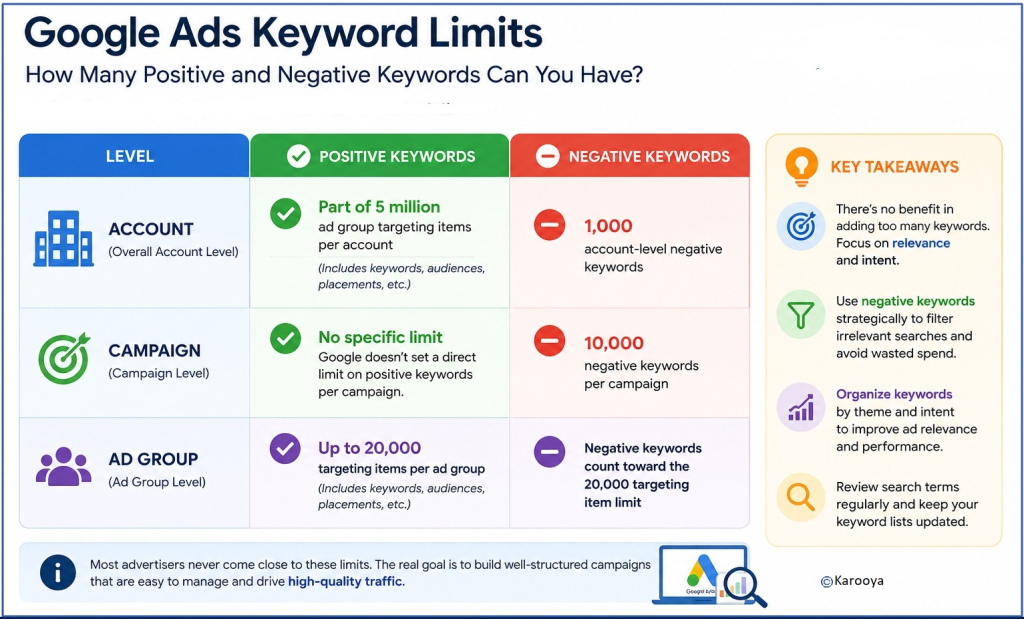
Google’s official account limits documentation does not specify a separate maximum number of keywords per account. Instead, keywords are included within the platform’s broader targeting limits.
Google states that an account can have up to 5 million ad group targeting items per account, and keywords are included in those targeting items.
Based on information published by Google, the following table outlines the limits for positive and negative keywords within an account, campaign, and ad group.
What It Means for Advertisers: Practical Takeaways
Google allows advertisers to use a large number of positive and negative keywords, so hitting the limit is rarely a concern. However, success in Google Ads comes from using relevant keywords, not from having a huge keyword list. Focus on quality and relevance rather than quantity.
Here are some takeaways:
1) More keywords are not always equal to better performance
Google’s improved match types, close variant matching, and AI-powered targeting have reduced the need for excessive keyword expansion. As a result, advertisers can focus more on relevant search intent rather than building large keyword lists.
2) Organising keywords always helps
Instead of adding too many different keywords to one ad group, organise them into groups by a common theme, product, or intent. This helps to create more relevant ads, improve Quality Score, and give users a better experience.
3) Think of Negative Keywords as your traffic gatekeepers
Negative keywords are as important as positive keywords. They help prevent ads from showing for irrelevant searches, reducing wasted spend and improving traffic quality. Regularly reviewing search term reports can also reveal new negative keyword opportunities.
4) Audit keyword list regularly
As campaigns evolve, keyword and negative keyword lists often accumulate duplicate, obsolete, or conflicting entries. Regular reviews help improve account efficiency and keep campaigns aligned with your marketing objectives.
5) Focus on relevance
A successful PPC campaign is not about showing your ads for every search. It’s about appearing for the searches that are most likely to lead to conversions and avoiding irrelevant traffic. Finding the right balance is key to long-term PPC success.
6) Finding the right balance
Though Google Ads allows advertisers to have thousands of keywords and negative keywords, a successful PPC account is not about that. It is all about maintaining relevance. A well-balanced account should typically have:
- A well-structured campaign which is aligned with your business goal
- Enough keywords to cover valuable search intent
- Enough negative keywords to filter irrelevant queries
Conclusion
There is no magic number of keywords or negative keywords that guarantees PPC success; it is all about striking the right balance. At the account level, your priority should be covering high-value search intent while filtering out waste. At the campaign level, focus on structuring your keywords around your budget constraints and macro goals. Finally, at the ad group level, give absolute priority to hyper-relevance.
When it comes to negative keywords, regularly review and refine your negative keyword lists. Doing so helps eliminate wasted ad spend, improve traffic quality, and ensure your ads reach the most relevant audience. The PPC keyword balancing act isn’t about having more or fewer keywords—it’s about having the right ones in the right places.
Related Links


Stop the wasted ad spend. Get more conversions from the same ad budget.
Our customers save over $16 Million per year on Google and Amazon Ads.