

This week’s PPCChat explored how PPC marketers navigate campaigns in industries where legal, compliance, or brand guidelines place strict limits on messaging. The discussion covered how advertisers maintain strong campaign performance when certain claims, offers, creative elements, or messaging are off-limits, how they turn legal and brand feedback into effective ad copy, and the compliant messaging strategies or creative workarounds that have delivered better-than-expected results.
Q1: When legal, compliance, or brand restrictions are part of the account from day one, how do you build them into your PPC strategy instead of treating them as a blocker later?
Buy legal team donuts… like a lot. @Aaronlevy
Disclaimers are a great way to do this (Microsoft has had them since 2021 and Google is testing them now). It’s worth noting that Microsoft doesn’t force you to give up ad creative real estate while Google does @navahhopkins
I think identifying what CAN be used and focusing on that can help a good amount. At the very least, it turns focus towards “what great messaging is possible for us” instead of “what great messaging is off limits”. @AnthonyMcDaniel
More seriously, you know the restrictions you’re facing are likely the same restrictions your competitors have, so you can do your best to work around them and highlight features/benefits that your competitors don’t have. If you DO win on rates, for the love of all that is holy share that as often as you can @Aaronlevy
Same goes for any other restrictions on strategy. For example, I currently work with a lot of clients who can’t use 1st party data, so we focus a ton of our energy on making sure their offline conversion tracking is as clean as possible. @AnthonyMcDaniel
I like to build it right into our templates so any time we work on ads or extensions it’s right there for the team to use and the client to highlight. @JuliaVyse
I’ve found that just asking potential clients the question about restrictions is already a strategic move. Show you’re tihnking ahead. @Pete_Bowen
@Aaronlevy that’s a great point. Where there are restrictions, there is likely a bit less competition, or at the very least, the competition is less competitive. So if you can find something that sets you apart and gives you an advantage, that may be something that other brands are not going the extra mile to do. @AnthonyMcDaniel
@AnthonyMcDaniel game is much easier to play when everyone has the same rules @Aaronlevy
@Aaronlevy, and when the game is too complex, some people choose not to play in the first place! @AnthonyMcDaniel
Tried giving donuts @Aaronlevy, lol, but legal are still mandating zero cookies across the board for one of my accounts….even the legal kind @DiiPooler
@DiiPooler, my gov clients are like this. We’ll take them out to lunch, and they insist on splitting the bill. ugh! @JuliaVyse
@JuliaVyse yeah, at my last agency, I handled all of our gov clients, and when we sent out holiday gifts, all we could do for them was holiday cards. What a bummer! @AnthonyMcDaniel
Yeah. Get ready for origami pop cards, gang! I WILL find a way to go all out @JuliaVyse
I have a client right now who’s one of the healthiest options in their market – but can’t advertise as “healthy”. We are targeting health-conscious keywords, with messaging that comes close but stays compliant. @williamhboggs
Q2: How do you approach ad landing page copy when the most direct or persuasive message is not approved?
I’m lucky in that my clients do their own LPs, so I just take them as they are and move forward. When we’re invited to suggest changes or upgrades, we keep the suggestions simple, bullet-pointed, and ready for use by a policy team, not the marketing team. @JuliaVyse
When it comes to ads and persuasive language, turn that impediment into your superpower: other people are smarmy grifters with their exclamation points and sales language. WE are on the level. @JuliaVyse
I feel like landing page copy doesn’t suffer as much from restrictions because (at least in my world) we’re just trying to generate a lead. Landing pages that tick the boxes of 1. we do what you’re looking for, 2. we’re reasonably competent, 3. we’re OK to work with, 4. we’ll get back to you usually convert clicks to leads. In some way, not being able to make a whole bunch of wild claims makes the page more authentic. @Pete_Bowen
Smiling lady pictures! Try to simplify language as much as possible so you’re not exclusively speaking legalise to potential customers. feature/benefit is usually a safe way to go as well. Similar to what @Pete_Bowen says, as long as you stick to “here is what we are and what we do,” it should be sufficient to test out variables even if you can’t use sexy language. @Aaronlevy
Kinda basic, but for me, I really want to know “why” something is not approved. Not only does it help me to write copy in the future that is more likely to be approved, but from time to time, it also allows me to clear up some misunderstandings that may actually get some messaging approved.
For example, if something’s disapproved simply due to vibes, I may take another shot at selling it in a different way to get buy-in, vs “we can’t do this because that phrase will get us shut down”. Two different situations that I’d handle differently if I know the reason. @AnthonyMcDaniel
Could in theory help you coach an agent too (if legal lets you use robots) fwiw on the ai side, most regulated folks I’ve chatted with are either using Gemini or Copilot and having a lot more success getting them approved by legal @Aaronlevy
@AnthonyMcDaniel Such a good point! In one case it’s been the opposite struggle, legal handed down a decision with basically zero explanation, and getting any real “why” passed down through the chain has been its own battle. @DiiPooler
I do think that what @Pete_Bowen is saying is pretty big too. It’s really easy sometimes to think we’re capable of being Don Draper or that our copy is gonna go down in history like an Apple ad.
Sometimes the best copy is simple and straightforward with no frills. Marketers love to fluff things up to be “cool” or “interesting” or “engaging”, but sometimes (especially when it comes to regulated industries) a customer just wants to know that you can deliver on whatever it is you do. @AnthonyMcDaniel
@DiiPooler Ugh, that’s frustrating. Makes you wonder if they even read the messaging, or just didn’t like something insignificant about it. @AnthonyMcDaniel
Q3: What helps you turn legal or brand feedback into usable PPC messaging instead of starting from scratch every time?
Recognize that your competitors face the same restrictions and figure out what makes your product different. For the Mad Men fans in here @williamhboggs
More donuts. But I think the comments in the last thread about asking for better feedback are important/invaluable. @Aaronlevy
I’ve been building what I call “brand books” within Claude for my clients. Each one has a cardinal rules section, and there I put the absolutes yes and no’s. If something is denied by legal/compliance, I’ll update the cardinal rules to include that denial and then have it check my currently running RSA headline/descriptions & Meta copy to confirm that there isn’t something similar that slipped through. Helping me keep this part of things organized instead of relying on unwieldy Google Sheets. @timmhalloran
Many of my restricted clients were solo-managed by me, so I mostly just remembered what those restrictions had been previously, and adjusted based on what I’d learned from previous copy submissions. @AnthonyMcDaniel
@timmhalloran That’s a smart system, way more actionable than a static sheet since it actually checks new copy against the rules instead of just storing them. Curious how you handle rebrands though, when the brand book itself needs to change, do you keep a version history so you’re not accidentally checking new copy against outdated rules? That seems like the trickiest part, the rules themselves becoming a moving target instead of a fixed reference. @DiiPooler
@DiiPooler that hasn’t come up yet but that’s a good question. Here’s a screenshot of a newer brand (redacted info blurred) that shows the “claim guardrails” section. This ones smaller but there are others that get pretty lengthy. I like the idea of adding time stamps to guardrail changes though! @timmhalloran
@timmhalloran Love that. Reminded my that our current company has an internal wiki that we use to store all kinds of info on clients and even our own agency. I’ve not got “develop client brand guidelines” on my to-do list for this week. @AnthonyMcDaniel
Nice, good idea to add it to a internal wiki. Might try that too. Overall it’s been super helpful. Especially when you’re switching between brands all day. It’s easy to confuse them when you’re working fast, so having a little back-up system to remind you of the important stuff is nice. @timmhalloran
Yeah, and I’d prefer to have that live outside of a chat, so others can access easily, or add things themselves. @AnthonyMcDaniel
I love this and have used versions of it often. Now I’m thinking about how we build this into our copy tools… @JuliaVyse
Q4: When approvals are slow or messaging options are limited, how do you decide what is still worth testing?
I definitely try to communicate to clients that slow response times in these kinds of things directly impacts our ability to test things. Can be tricky, though. Have to not be accusatory, but still share the downstream impacts of delayed responses. On top of that, I try to just make tests last a bit longer. It’s usually not a bad idea to get more data into a test, unless the test shows overwhelming results that would in fact, inhibit performance if we don’t end it and move towards a winner. But if I can keep that test running, just gives that little bit more statistical significance. @AnthonyMcDaniel
And also keeps me from having huge gaps in between tests where a client may think I’M the one just twiddling my thumbs. @AnthonyMcDaniel
Totally agree on letting tests run longer when approvals are slow, more statistical significance is worth the wait if results aren’t already overwhelming. On what’s still worth testing when messaging itself is locked down, I’ve found you can shift the test entirely off copy: layout/CTA placement, image vs video creative, audience signal combinations, even landing page structure (above-the-fold ordering, nav suppression) can move the needle @DiiPooler
I like to talk about ease of answer in the copy. ie, my non-negotiable, lengthy form has x number fields, so I like to say ‘in only 8 steps’ that way the idea of filling in fields is baked in and can help with pre-qualification. This is a major issue with gov clients who often have WAY more than 8-step form fields. @JuliaVyse
Sadly had to hop to a meeting, but honestly I had the MOST fun working in restricted industries. having tight parameters forced me to get as clever as possible and. feel like I did my best work with these. @Aaronlevy
Q5: What is one compliant messaging angle or workaround you’ve seen perform better than expected?
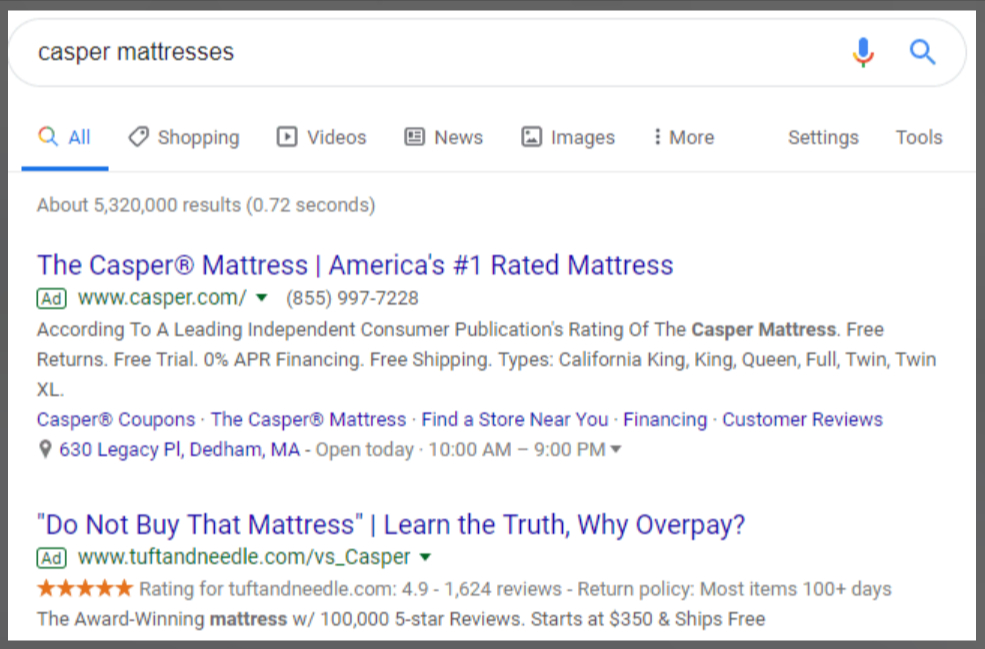
I’m not sure how well they perform, but I’m often intrigued by the creative ad copy brands will think of for competitor search campaigns when you can’t mention the competitor you’re bidding on. @AnthonyMcDaniel For Example:
Used to have a few fintech SaaS style start-ups so we’d deal with FTC/SEC compliance language quite a lot. There would be instances where we’d lead with the disclaimer or what was considered a weakness because it worked as a strength to the audience we wanted clicking on our ads, and it weeded out low-quality clicks which increased CVR (side benefit). E.g. a start-up wanting to position itself as a crowdsourcing commercial equity focused on “for the masses, not just institutional investors” or something along those lines. Worked well performance-wise, even though financial publications looked at it as a negative. @timmhalloran
PPCChat Participants
- Julia Vyse @JuliaVyse
- Tim Halloran @timmhalloran
- Anthony McDaniel @AnthonyMcDaniel
- Boggs @williamhboggs
- Aaron Levy @Aaronlevy
- Dii Pooler @DiiPooler
- Navah Hopkins @navahhopkins
- Peter Bowen @Pete_Bowen
Related Links

Stop the wasted ad spend. Get more conversions from the same ad budget.
Our customers save over $16 Million per year on Google and Amazon Ads.