

For the past two decades, PPC advertisers have built entire strategies around three fundamental tools: broad match, phrase match, and exact match. We’ve debated their merits, crafted intricate structures, and spent countless hours deciding which match type deserves our budget. AI Max has fundamentally changed this relationship. Not by explicitly removing match types, but by making them less relevant to how decisions are actually made.
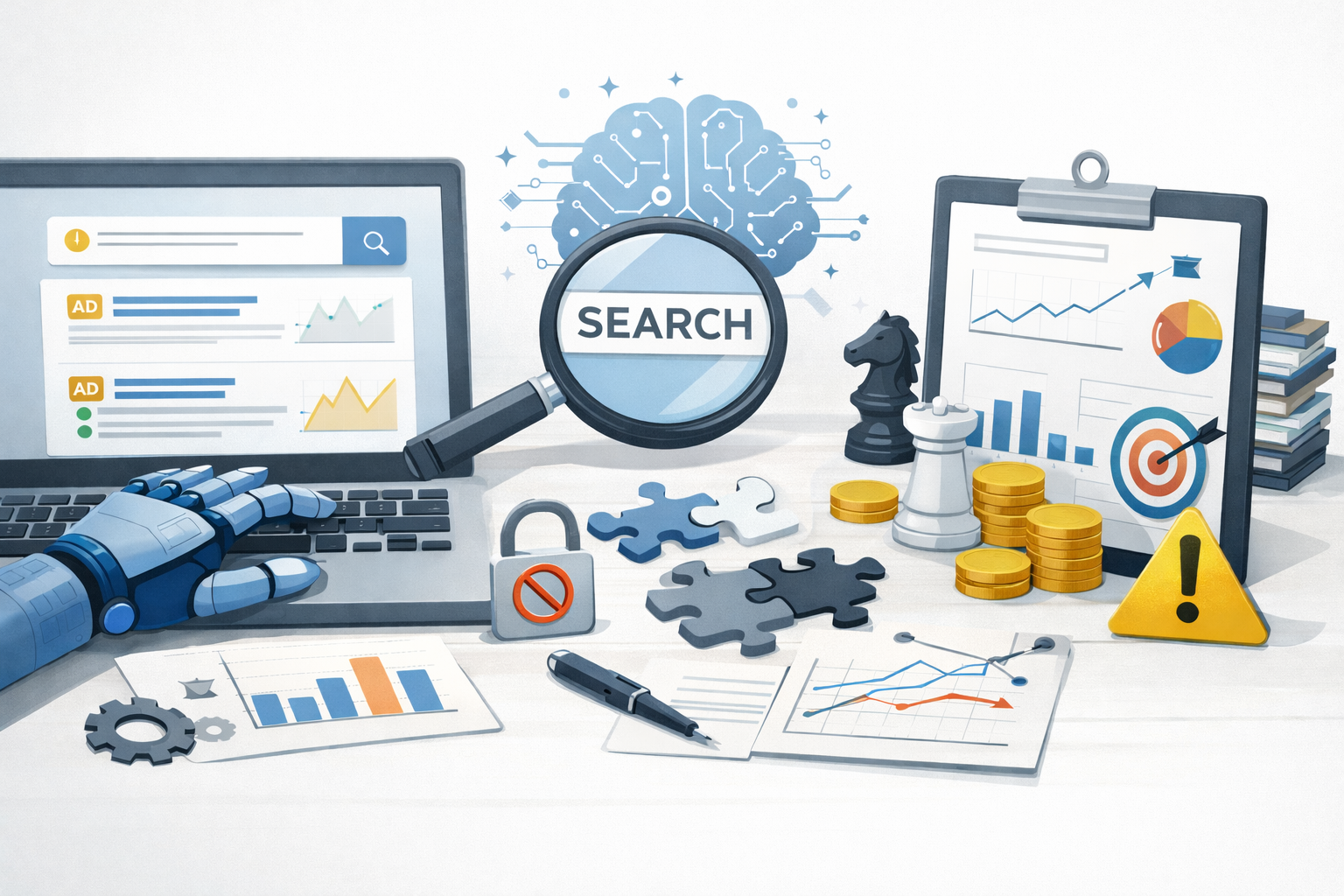
If AI Max is the future, then the entire match type framework may become obsolete.
But before we celebrate efficiency or mourn lost control, we need an honest conversation about both sides of this transformation. Because what we’re losing isn’t just complexity—it’s capability.
TL;DR
AI Max can simplify search management and unlock faster learning at scale by shifting relevance decisions from keyword rules to intent prediction. It reduces mechanical workload and handles ambiguous queries better than rigid match types, especially in large or fast-changing accounts.
The trade-off is reduced predictability, lower query-level transparency, and a much higher dependence on clean data, clear intent signals, and strong guardrails like negative keywords.
Advertisers don’t gain more control with AI Max — they gain a different kind of control. The real decision isn’t manual vs AI Max — it’s which risks an advertiser is better prepared to manage.
Why AI Max Is Even on the Table?
AI Max campaigns operate on fundamentally different logic than traditional search. Instead of asking “which match type should I use?”, they ask “what outcome are you trying to drive?” The system then analyzes hundreds of signals to find users likely to convert. Manual systems struggle to evaluate this complexity in real time.
AI Max attempts to solve this by analyzing various signals:
- Predicting intent instead of matching syntax
- Optimizing toward outcomes rather than rules
- Historical conversion data
- Real-time intent signals
- Using signals that humans can’t process at scale
What Advertisers Gain With AI Max
AI Max does offer real advantages — and it’s important to acknowledge them.
Reduced Mechanical Work
AI Max reduces the need for hands-on keyword management. Advertisers spend less time segmenting match types, layering keywords, or repeatedly restructuring campaigns to capture new variations. This shift can free up effort for higher-level work such as intent definition, creative strategy, and performance analysis.
Faster Learning at Scale
AI-driven systems can test and learn across far more queries, contexts, and combinations than manual setups allow. For large accounts or markets where search behavior changes quickly, this ability to process complexity at speed can accelerate learning and surface opportunities that would be difficult to uncover manually.
Better Handling of Ambiguous Intent
Not all search queries fit neatly into Exact or Phrase match logic. Some are vague, contextual, or evolve over time. AI Max is better equipped to interpret these gray areas by evaluating patterns and signals rather than relying solely on predefined keyword boundaries.
What Advertisers Give Up — or Risk Giving Up?
At the same time, AI Max introduces real concerns.
Loss of Predictability
Traditional match types gave advertisers a clear mental model for understanding why ads showed for certain queries. With AI Max, relevance decisions are driven by internal models rather than visible rules, and the system doesn’t always explain its reasoning. This makes performance harder to interpret and diagnose, especially when results shift without obvious triggers.
Reduced Tactical Control
AI Max changes who decides how far a keyword can stretch. Advertisers no longer define acceptable variations upfront; that judgment is handled by the system in real time. While this can unlock scale, it also reduces hands-on control, making it harder to apply precise, preemptive restrictions.
Higher Dependence on Data Quality
AI Max performs only as well as the signals it receives. Clean conversion tracking, meaningful goals, and clearly defined intent become critical inputs rather than best practices. When data is incomplete or misaligned, the system doesn’t just make small mistakes—it scales them across the account.
Do Advertisers Have to “Accept” AI Max?
No. At least not universally.
AI Max is an option, not a mandate.
There could still be use cases where advertisers may prefer more manual approaches:
- Highly regulated industries
- Niche products with narrow intent
- Accounts with limited conversion data
- Teams that rely heavily on query-level insight
In these cases, traditional keyword structures and match types can still provide clarity and control.
For many advertisers, the most realistic future isn’t “AI Max only” or “manual forever”. It’s parallel experimentation.
- AI Max for scalable discovery and growth
- Structured campaigns for precision and predictability
- Shared learnings between both approaches
This allows advertisers to:
- Validate AI decisions
- Retain confidence in performance
- Avoid over-reliance on a single system
How AI Max Changes the Advertiser’s Role (If Chosen)
If advertisers do adopt AI Max, their role doesn’t disappear — it changes. They move away from:
- Keyword micromanagement
- Match-type sculpting
- Query-level decision making
And toward:
- Defining success clearly
- Designing strong conversion signals
- Setting boundaries through exclusions
- Interpreting patterns instead of individual queries
This is a shift in responsibility, not a removal of it.
If AI Max is indeed the future, here’s what’s worth considering:
If You’re Ready:
- Test AI Max now while you still have traditional campaigns to compare against
- Focus on improving creative, landing pages, and conversion tracking—these become your main levers
- Accept that you’ll have less granular control, and that might be okay
If You’re Concerned:
- Document what’s working in your current exact/phrase match structure while you can
- Build the business case for maintaining traditional campaigns as long as possible
- Prepare alternative strategies if AI Max doesn’t deliver for your specific use case
Why Negative Keywords Become More Important With AI Max?
As AI Max relies on broader interpretation and exploration, negative keywords shift from being a cleanup tool to a primary control mechanism. With fewer upfront restrictions, negatives define the boundaries the system must not cross. Without a strong negative keyword strategy, AI Max can continue testing irrelevant or low-value intent, gradually increasing wasted spend. In an AI-driven setup, negatives are no longer optional optimizations—they are essential guardrails that help align automation with business intent.
For example, an advertiser selling enterprise-level PPC software may want to attract queries around “PPC automation tools” or “paid search optimization.” In an AI Max setup, the system might also explore related searches like “free PPC tools,” “PPC course,” or “learn Google Ads.”
While these queries are contextually related, they don’t reflect buying intent. Without negative keywords such as free, course, or training, AI Max may continue allocating spend to these areas as part of its learning process. Adding these negatives clearly signals what intent should be excluded, helping the system focus exploration on commercially relevant demand.
What Advertisers Must Be Cautious About With AI Max
- Over-trusting automation early
AI Max needs time and data to stabilize; early performance swings shouldn’t drive big decisions. - Weak conversion signals
The system optimizes exactly for what’s tracked—poor or inflated goals lead to poor outcomes at scale. - Lower query-level transparency
Understanding why certain queries trigger becomes harder, shifting analysis from queries to patterns. - Intent drift over time
Without regular reviews, AI Max may expand into adjacent intents that dilute efficiency. - Negative keywords become critical
Negatives act as hard boundaries; weak negative coverage increases irrelevant spend. - Creative and landing page influence
Ads and pages strongly shape relevance—vague messaging invites the wrong traffic. - Quiet budget leakage
Exploration can spread spend thinly across low-impact queries without obvious red flags. - Short-term volatility
Automated adjustments can cause swings; frequent manual changes may disrupt learning. - Platform-driven optimization logic
AI decisions follow platform assumptions, which may not always align with advertiser priorities. - Shift in advertiser role
Less keyword control means more responsibility for intent definition and signal quality. - Not right for every account
Low-volume, niche, or regulated advertisers may need tighter manual control. - Testing discipline still required
AI Max should be tested methodically—blind adoption makes performance hard to interpret.
FAQs
1. Does AI Max mean advertisers must stop using manual search campaigns?
No. AI Max is an option, not a requirement. Manual campaigns remain relevant for accounts that need tighter control, clearer predictability, or operate with limited data.
2. Are keyword match types becoming irrelevant?
Match types still exist, but their influence is reduced in AI-driven systems. They act more as directional inputs than strict filters, especially when automation determines relevance dynamically.
3. Why does AI Max rely so heavily on conversion data?
AI Max optimizes toward outcomes, not rules. Without accurate and meaningful conversion signals, the system cannot distinguish between valuable and low-quality intent.
4. Does AI Max reduce advertiser control?
It reduces tactical control over query matching, but increases the need for strategic control through intent definition, exclusions, creative clarity, and measurement discipline.
5. Why are negative keywords more important with AI Max?
With broader exploration, negative keywords act as hard boundaries. They prevent the system from repeatedly testing irrelevant or low-value intent that still appears contextually related.
6. Is AI Max suitable for small or niche advertisers?
Not always. Accounts with low conversion volume, narrow intent, or regulatory constraints may struggle to provide enough signal for AI Max to perform reliably.
7. Can AI Max performance be unstable?
Yes, especially during learning phases. AI systems can adjust quickly based on signals, which may cause short-term volatility before stabilizing.
8. How should advertisers evaluate AI Max fairly?
Through controlled testing. AI Max should be tested alongside structured campaigns with clear benchmarks, not adopted wholesale without comparison.
9. Does AI Max replace the need for skilled PPC teams?
No. It changes the skill set required. Less time is spent on keyword execution, and more on strategy, signal governance, and performance interpretation.
10. What’s the biggest risk with AI Max?
Not automation itself, but unclear intent. When advertisers fail to define what matters—and what doesn’t—the system fills the gaps, often at scale.

Stop the wasted ad spend. Get more conversions from the same ad budget.
Our customers save over $16 Million per year on Google and Amazon Ads.