

In today’s digital world, online advertising has become an essential requirement. With this increasing demand to rank at the top of search engine results, competition has increased. To establish a strong online presence, you have to plan your advertising budget as per your competitors.
Most businesses rely on Google Ads, which follows a bid-based strategy. But have you ever wondered how much your competitors are investing in Google Ads?
Researching a competitor’s Google Ads budget can be tricky, as Google does not publicly share that information. However, you can use a combination of tools and techniques to gain valuable insights into their advertising strategies and estimate their potential spending.
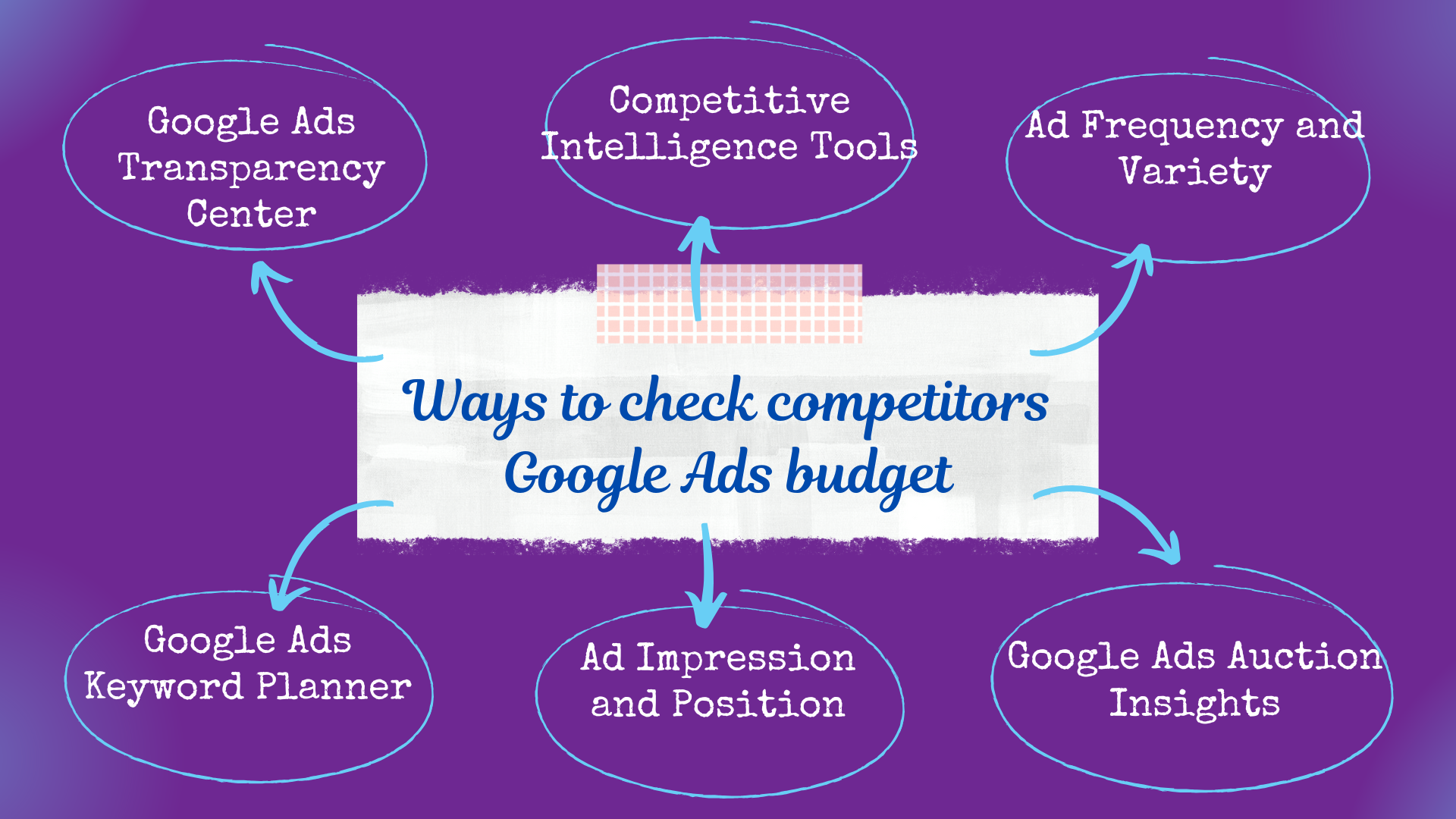
1. Use Google Ads Transparency Center
Google’s Ad Transparency Center helps to learn more about the ads you see across Google platforms. “It’s designed to give you even greater insight into the advertisers you see.. While it doesn’t show the budget, it gives insights into their active campaigns, ad formats, and regions they target.
2. Use Google Ads Auction Insights
Google Ads auction insights provides valuable data on your competitors’ performance in the ad auctions. It reveals metrics like impression share, overlap rate, and outranking share, which can indicate how frequently your competitors’ ads appear compared to yours. By observing changes in these metrics, you can infer potential shifts in their budget or bidding strategies.
3. Use Google Ads Keyword Planner
If your competitors focus on high-volume, competitive keywords, they likely have a significant budget. Moreover, this free Google tool allows you to estimate the cost-per-click (CPC) for relevant keywords. By studying the CPC of their targeted keywords, you can evaluate their anticipated ad spend. The formula to know the estimated budget is:
Estimated Budget= Estimated Clicks per Month × Average CPC
So, if a business expects to receive 8000 clicks a month and the average CPC is ₹2.00, the estimated budget would be:
Estimated Budget = 8000 x 2.00 = ₹16,000
4. Use Competitive Intelligence Tools
Third-party tools like SEMRush, Spyfu, iSpionage and Ahrefs can be very useful. They offer competitive analysis features that can provide estimates of competitors’ paid search activity by:
- Revealing the keywords competitors are bidding on
- Knowing their ad copies and the quality of the landing page
- Estimating traffic and potential spending
While these tools don’t provide exact budget figures, they offer valuable insights into your competitors’ overall advertising efforts. Here is how:
- SEMrush – Shows estimated ad positions, keywords, and CPC data.
- SpyFu – Reveals competitors’ historical ad performance, keyword bidding strategies, and estimated budgets.
- Ahrefs – Gives insights into paid keywords, ad copies, and estimated traffic.
- iSpionage – Tracks competitor PPC strategies, including ad copy and budget estimates.
5. Analyse Ad Impression and Position
Keeping an eye on your competitor’s ad impressions and rankings can give you a sense of how much they are spending. Moreover, if their ads consistently appear in top positions for competitive keywords across different searches, it’s a strong sign that they’re investing heavily.
To analyze competitor keywords, search in incognito mode to see which ads consistently appear at the top. Additionally, leverage the Google Ad Preview & Diagnosis Tool to check ad placements without affecting impressions. Although not meant for competitor analysis, this tool lets you see which competitor ads are showing up for your target keywords, giving you useful PPC insights.
6. Analyse Ad Frequency and Variety
Check how often your competitor’s ads show up for key search terms. If their ads appear consistently, they likely have a big budget. A variety of ad copies and extensions also suggest they’re investing in testing and optimization, which usually requires more spending. Consider these questions when evaluating their online presence and ad strategy:
- Are they consistently in the top positions?
- Are their ads appearing frequently throughout the day?
- Do they use multiple variations of headlines and descriptions?
- Do they increase their ad activity during specific seasons or promotions?
- Are they constantly testing and refining their ad copy and landing pages?
If your competitors are running Facebook or Instagram ads, you can use Meta Ad Library to observe the variety.
The Budget Mystery: Solved (Partially)
Gaining an understanding of your competitor’s ad spend and tactics helps you stay competitive. Keep these thoughts in mind while doing the analysis:
- The data you collect offers insights, but not exact numbers
- Focus on competitor strategies instead of their exact spending
- Use these insights to improve your own Google Ads and budget
These insights are a great starting point, but using strategies and tools gives you a clearer view of your competitors’ Google Ads, helping you make smarter advertising decisions.
Frequently Asked Questions: Competitors’ Google Ads Budgets
Understanding competitors’ Google Ads budgets often raises practical questions around visibility, bidding behavior, and spend signals. The FAQs below address common doubts advertisers have when estimating competitor budgets, clarifying what can and cannot be inferred from Google Ads data and competitive insights.
Can I see my competitor’s exact Google Ads budget?
No. Google does not share exact budget or spend data for advertisers. Any competitor budget insight is always an estimate based on auction behavior and visibility.
Why analyze competitor budgets if exact numbers aren’t available?
Because budget signals provide market context. They help explain CPC increases, impression share losses, and visibility changes that aren’t visible inside your own account.
Does a top ad position mean a competitor has a bigger budget?
Not always. High positions can result from strong Quality Scores or focused bidding, but consistent top visibility across many keywords often indicates higher spend.
If a competitor appears on almost every search, do they have an unlimited budget?
No. This usually means high prioritization of specific keywords, not unlimited spend. Many advertisers concentrate budget on a narrow set of high-value terms.
Why do some competitors’ ads run all day while mine stop early?
This is usually due to budget pacing and bidding strategy. Competitors may spread spend evenly, bid selectively by hour, or accept higher CPAs.
Can smaller advertisers compete with big-budget competitors?
Yes. Strong intent targeting, higher relevance, and better landing page experience can outperform larger budgets in many auctions.
Are competitors spending more, or just bidding aggressively?
Aggressive bids do not always mean high total spend. Some advertisers bid high on limited keywords while maintaining strict daily budgets.
Why do competitors suddenly disappear from auctions?
Common reasons include paused campaigns, budget reallocation, or seasonality. A temporary absence doesn’t mean they’ve exited the market permanently.
Does targeting broad keywords mean a competitor has a large budget?
Often, yes. Broad keywords typically require higher budgets due to inefficiency, though some advertisers use them selectively with tight controls.
How accurate are competitor spend estimates from third-party tools?
They are directional, not exact. These estimates are best used for comparing competitors and identifying trends, not determining precise spend.
How often should competitor budget signals be reviewed?
Monthly reviews are sufficient for most accounts. Review sooner if you see sudden CPC spikes or impression share drops.
Should I increase my budget just because competitors are spending more?
No. Budget decisions should be based on your own performance and ROI, not competitor spend alone.
Can competitor budget analysis help during account audits?
Yes. It provides external market context that explains performance changes and supports more accurate audit conclusions.
What is the safest way to respond to aggressive competitor spending?
Avoid budget wars. Focus on high-intent keywords, efficiency, and relevance before increasing spend.
What is the biggest mistake advertisers make with competitor budget analysis?
Treating estimates as facts. Competitor budget insights should guide strategy, not dictate decisions.
Related Links



Stop the wasted ad spend. Get more conversions from the same ad budget.
Our customers save over $16 Million per year on Google and Amazon Ads.