

As we navigate the evolving landscape of Amazon Advertising in 2026, one question keeps surfacing: Is the match type campaign strategy still relevant? The short answer is yes—but with important nuances.
Despite Amazon’s continuous algorithm improvements and the rise of automation, match type strategy remains a cornerstone of successful Amazon PPC campaigns. However, the way we implement it has evolved significantly. This comprehensive guide will show you how to leverage match type strategies effectively in today’s Amazon advertising ecosystem.
What is Match Type Campaign Strategy?
Match type campaign strategy is a systematic approach to organizing your Amazon Sponsored Products campaigns based on keyword match types. Instead of mixing broad, phrase, and exact match keywords in a single campaign, you create separate campaigns for each match type.
This segmentation gives you:
- Granular control over bids and budgets
- Clear visibility into performance by match type
- Better optimization capabilities
- Improved data analysis for decision-making
The Three Match Types Explained
1. Broad Match
How it works in 2026: Broad match keywords trigger ads for searches that include your keyword terms in any order, along with close variations, synonyms, and related searches. Amazon’s machine learning has become significantly more sophisticated, meaning broad match now captures more relevant traffic than in previous years.
Example:
- Keyword:
wireless headphones - May show for: “bluetooth headphones wireless,” “wireless earbuds,” “cordless headphones for running,” “best wireless headphones 2026”
When to use: Discovery and research phases, finding new high-converting search terms
2. Phrase Match
How it works in 2026: Phrase match requires the exact phrase to appear in the search query, but allows for additional words before or after. Amazon’s algorithm now better understands user intent, making phrase match more precise while still maintaining reach.
Example:
- Keyword:
wireless headphones - May show for: “best wireless headphones,” “wireless headphones for gym,” “buy wireless headphones”
- Won’t show for: “headphones wireless bluetooth” (order changed)
When to use: Mid-funnel campaigns, balancing discovery with control
3. Exact Match
How it works in 2026: Exact match shows ads only for the specific keyword or very close variations (plurals, misspellings, abbreviations). This is your most targeted match type.
Example:
- Keyword:
[wireless headphones] - May show for: “wireless headphones,” “wireless headphone” (singular), “wireles headphones” (misspelling)
- Won’t show for: “best wireless headphones,” “wireless headphones 2026”
When to use: High-converting keywords, protecting margins, maximum control
The Match Type Campaign Structure: A 2026 Framework
Campaign Architecture
The foundation of your match type strategy involves creating three distinct campaigns, each serving a specific purpose in your keyword funnel.
| Campaign Type | Purpose | Bid Strategy | Number of Keywords |
| Research Campaign (Broad Match) | Discover new search terms and understand customer behavior | Conservative: 30-40% below target CPC | 10-20 seed keywords |
| Testing Campaign (Phrase Match) | Validate promising keywords before full investment | Align with target ACoS by working backwards from product price and conversion rate | Top performers from broad match |
| Performance Campaign (Exact Match) | Maximize ROI on proven keywords | Aggressive: 20-30% above phrase match bids for proven converters | Consistently converting keywords only |
The Cross-Negative Strategy: Preventing Keyword Cannibalization
One of the most critical aspects of match type campaign strategy in 2026 is preventing your keywords from competing against each other. This is where the cross-negative keyword strategy becomes essential.
How It Works
When you run the same keyword across multiple match types, Amazon’s algorithm may match your ad to the same search query from different campaigns. This creates internal competition, leading to:
- Higher overall costs (you’re bidding against yourself)
- Unpredictable ad delivery
- Difficulty tracking true performance by match type
- Wasted budget on less efficient match types
The Solution: Add your keywords as negative match types in broader campaigns to create a “waterfall” effect that ensures each search query triggers only the most targeted keyword available.
Implementation Rules
The cross-negative strategy requires adding your keywords as negatives in broader match type campaigns to create a clean hierarchy. Here’s how to implement it with specific examples
Cross-Negative Rules (Simple & Non-Negotiable)
Cross-negative keywords are often misunderstood. They are not meant to “control” broad match expansion, nor are they a substitute for poor keyword selection. In a modern match type structure, cross-negatives exist for one reason only:
To route search queries to the most appropriate intent layer.
When implemented correctly, they prevent internal competition without choking discovery.
| Campaign Type | Primary Intent | Keywords Used | Cross-Negatives to Apply | Why This Is Required |
|---|---|---|---|---|
| Broad Match (Discovery) | Explore concepts, use cases, and adjacent demand | Concept-level and use-case keywords (e.g. marathon shoes, trail running footwear) | • Phrase match keywords (as negative phrase) • Exact match keywords (as negative exact) | Prevents broad match from capturing high-intent searches that belong in phrase or exact campaigns |
| Phrase Match (Validation) | Test commercial modifiers and buying language | Modifier-based phrases (e.g. best running shoes, running shoes for men) | • Exact match keywords (as negative exact) | Ensures pure head-term searches route directly to exact match for efficiency |
| Exact Match (Performance) | Capture and scale proven intent | High-intent head terms and top performers | • No match-type cross-negatives • Only universal irrelevant negatives | Exact match is the final destination; it should receive traffic, not deflect it |
Example: Running Shoes (Practical Illustration)
| Campaign | Active Keywords | Cross-Negatives Added |
|---|---|---|
| Broad Match | marathon shoes shoes for long distance running trail running footwear | “running shoes” “best running shoes” “running shoes for men” [running shoes] [men running shoes] |
| Phrase Match | “best running shoes” “running shoes for men” | [running shoes] [men running shoes] |
| Exact Match | [running shoes] [men running shoes] | None (only universal negatives like free, repair) |
How Queries Route With This Setup
| Search Query | Triggered Campaign | Reason |
|---|---|---|
| running shoes | Exact | Head-term intent protected |
| best running shoes | Phrase | Modifier-based buying intent |
| running shoes for men | Phrase | Commercial variation |
| shoes for long distance running | Broad | Exploratory use-case query |
| trail running footwear waterproof | Broad | Concept expansion |
This creates a clean waterfall, not overlap.
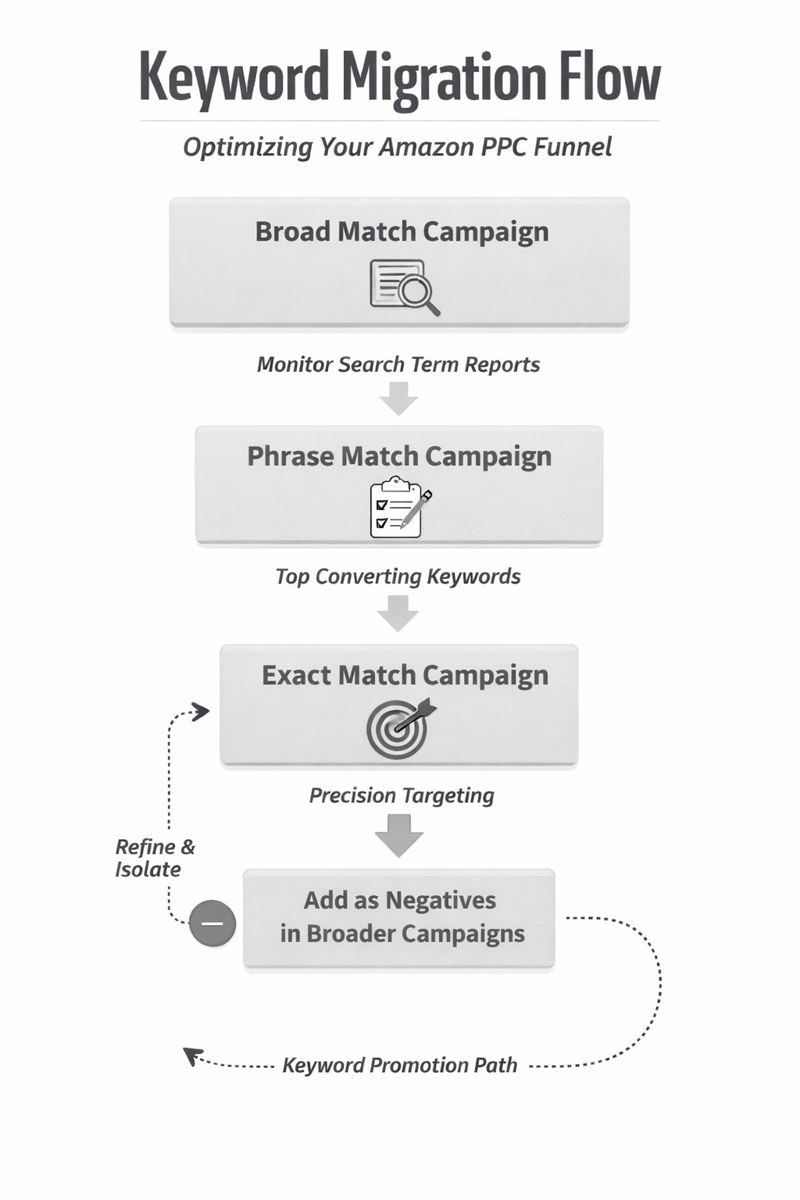
At first glance, the keyword migration flow—moving search terms from broad to phrase to exact—may seem mechanical or even old-fashioned in an era of AI-driven bidding and automated targeting.
But in reality, this flow continues to work in 2026 because it mirrors how customer intent reveals itself over time.
Amazon’s algorithms can optimize bids and placements, but they still rely on clean signals. The keyword migration flow creates those signals by progressively narrowing intent, isolating performance, and ensuring each keyword is evaluated at the right level of control.
Rather than fighting automation, this framework feeds it better data.
Step-by-Step Implementation
Step 1: Launch Broad Match (Research)
- Manual Sponsored Products campaign
- 10–20 highly relevant seed keywords
- Conservative bids (≈30% below target)
- Budget ≈20% of total
Step 2: Harvest Search Terms
- Review every 3–7 days
- Look for:
- Conversions
- Strong CTR + relevance
- Promote winners to phrase match
Step 3: Launch Phrase Match (Testing)
- Add successful broad terms as phrase
- Bids aligned to target ACoS
- Budget ≈30%
- Add irrelevant terms as negatives
Step 4: Promote to Exact
Promotion criteria
- ≥5 conversions
- Stable performance over 2–4 weeks
- Acceptable ACoS
Exact campaigns receive the largest budget share.
Step 5: Apply Cross-Negatives
This step is mandatory. Without it, the structure breaks.
Common Mistakes to Avoid
1. Mixing Match Types in One Campaign
Adding broad, phrase, and exact match keywords together in a single campaign eliminates your ability to optimize bids and budgets by match type performance. Separate campaigns for each match type from day one to maintain granular control and clean performance data.
2. Skipping Cross-Negatives
Running the same keyword across multiple match types without cross-negatives creates internal competition where your campaigns bid against each other, driving up costs. Always add exact and phrase negatives to broad match campaigns and exact negatives to phrase match campaigns to ensure each search query triggers only one keyword.
3. Promoting Keywords Too Early
Moving keywords to exact match after just one or two conversions leads to decisions based on insufficient data. Wait for statistical significance by requiring minimum five conversions or two to four weeks of consistent performance before promoting keywords to exact match.
4. Cutting Broad Match Entirely
Shutting down broad match campaigns once exact match performs well means you stop discovering new opportunities as customer search behavior evolves. Always maintain a discovery campaign at 10-20% of budget to continuously feed your phrase and exact match campaigns with fresh keywords.
5. Equal Budget Split Across Match Types
Splitting budget equally across all match types ignores performance differences and business stage needs. Let data guide allocation with new products needing more discovery (40% broad) while established products should weight toward proven keywords (50-60% exact).
6. Over-Segmenting Too Soon
Creating dozens of micro-campaigns before understanding what works fragments your budget and prevents meaningful insights. Start with three campaigns per product line (one per match type) and only segment further once you have sufficient data justifying the complexity.
7. Ignoring Search Term Reports
Forgetting to review search term data regularly means missing opportunities to harvest winning keywords and wasting budget on irrelevant searches. Schedule weekly search term report reviews and make keyword harvesting part of your routine optimization process.
8. Inadequate Budget Allocation
Running campaigns with budgets too small (under $10 daily per campaign) prevents generating actionable data. If total budget is limited, start with phrase and exact match only, adding broad match for discovery only once you scale to $50+ daily total spend.# Amazon Ads Match Type Campaign Strategy: The Complete 2026 Guide
FAQs: Match Type Campaign Strategy
Q: How many keywords should I start with in my broad match campaign?
Start with 10-20 highly relevant broad match keywords. Too many keywords will dilute your data and make it harder to identify winners. You can always add more as you gather data and understand what’s working.
Q: What if my broad match campaign isn’t discovering any good keywords?
If after 2-3 weeks you’re not finding valuable search terms, try these solutions:
- Expand your initial keyword list with related terms
- Check your bids—they may be too low to win impressions
- Review your product listing to ensure it’s optimized for relevance
- Consider that your product may be very niche, requiring more targeted initial keywords
Q: Can I use this strategy with automatic campaigns?
Yes, but with modifications. Use automatic campaigns as an additional discovery layer alongside broad match. When you find winning search terms in automatic campaigns, add them as keywords in your manual campaigns following the same broad → phrase → exact progression.
Q: How long before I see results from this strategy?
Expect to see initial insights within 7-10 days and measurable improvements within 30-45 days. The full benefit typically materializes after 3-4 months as you build a robust exact match campaign with proven keywords.
Q: Should I pause my broad match campaign once I have enough exact match keywords?
No. Continuous keyword discovery is essential. Customer search behavior evolves, new competitors emerge, and seasonal trends change search patterns. Maintain your broad match campaign at 15-25% of budget even when exact match is performing well.
Q: What’s the minimum budget needed to make this strategy work?
You need enough budget to adequately fund each campaign tier. As a minimum, start with at least $30-50/day total budget ($10-15 per campaign). Below this threshold, you won’t generate enough data to make informed decisions.
Q: How do I handle branded vs. non-branded keywords in this structure?
Create separate campaign sets for branded and non-branded keywords. Branded keywords typically have higher conversion rates and deserve their own campaigns with separate budgets and bidding strategies. This gives you four campaign types: Branded (broad, phrase, exact) and Non-branded (broad, phrase, exact).
Q: What if my exact match keywords stop converting?
This can happen due to increased competition, seasonality, or market saturation. When exact match performance declines:
- Review competitor activity and adjust bids if needed
- Check your product listing and pricing
- Ensure inventory levels are healthy
- Consider that customer preferences may have shifted—return to broad match for fresh discovery
- Evaluate if the keyword’s search volume has changed
Q: How does this strategy work with Amazon’s new AI features?
Amazon’s AI and machine learning features (like Performance+ campaigns) complement match type strategy rather than replace it. The structure provides cleaner data that helps Amazon’s algorithms learn faster. You can use AI-powered bid automation within each match type campaign while maintaining the strategic separation.
Q: Should I use the same negative keywords across all campaigns?
Use a strategic tiered approach:
Standard Negative Keywords (universal waste terms): Apply these across ALL campaigns – these are irrelevant terms you never want to trigger:
- Clearly irrelevant product terms
- Inappropriate or off-brand searches
- Wrong product categories
Cross-Negative Keywords (match type isolation): These are essential for preventing internal competition:
- In Broad Match Campaign: Add your exact and phrase match keywords as negative exact and negative phrase
- In Phrase Match Campaign: Add your exact match keywords as negative exact
- In Exact Match Campaign: No cross-negatives needed
How Has This Been Working for You?
If you’ve ever felt that your Amazon Ads performance is inconsistent—good weeks followed by sudden spikes in CPCs or wasted spend—chances are the issue isn’t bidding or budgets. It’s structure.
This match type–led, intent-driven setup works because it reflects how shoppers actually search: they explore, refine, and then commit. Accounts that follow this flow consistently report:
- Cleaner search term reports
- Faster identification of winning keywords
- Better budget control as CPCs rise
You’ll see similar frameworks discussed (in different forms) across seasoned Amazon PPC practitioners—whether it’s keyword harvesting models shared by agencies, case studies from sellers restructuring bloated accounts, or teardown posts that show ACoS improving after separating intent layers rather than adding more automation.
But the real proof isn’t in someone else’s dashboard—it’s in yours.
If you’re already running Amazon Ads, take one product and try this:
- Split discovery, validation, and performance clearly
- Apply cross-negatives intentionally, not defensively
- Let search terms guide promotion—not assumptions
Then watch what changes over the next 30–45 days.
And if you’ve already experimented with match type separation—what’s been your experience so far?
Did it simplify optimization, or did it surface issues you hadn’t noticed before?
That feedback loop is where the real gains begin.
You can also read:

Stop the wasted ad spend. Get more conversions from the same ad budget.
Our customers save over $16 Million per year on Google and Amazon Ads.