

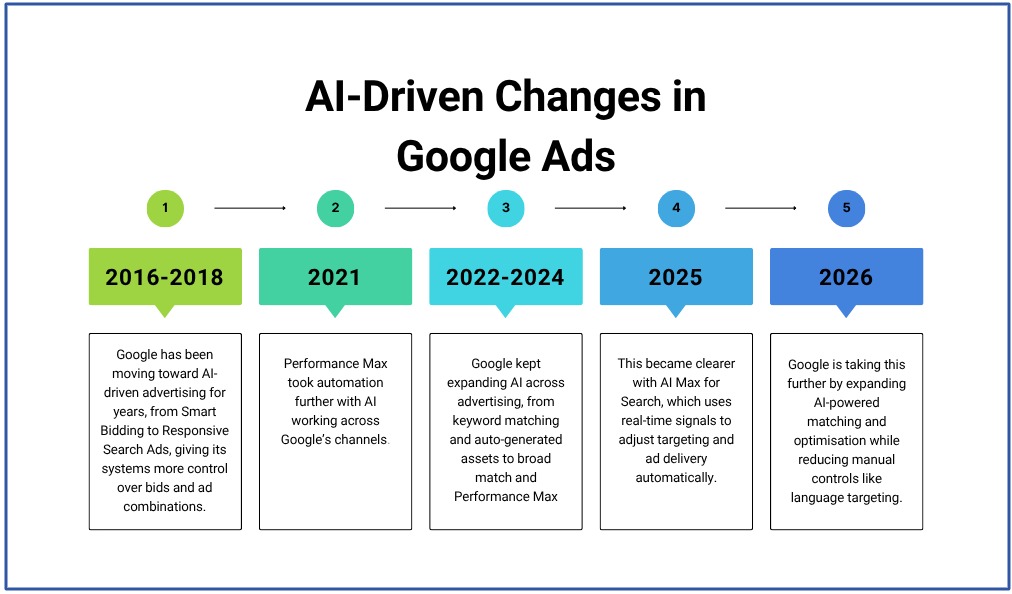
Google has been gradually bringing more AI into Google Ads for years, from matching and bidding to campaign optimisation. Removing language targeting from Search campaigns is simply the latest move in that ongoing shift toward letting AI make more of these decisions.
Google Ads is taking another step towards AI-driven change. In a recent LinkedIn post, Google Ads Liaison Ginny Marvin confirmed that:
Starting in September 2026, campaign-level language targeting will disappear from Search and Performance Max campaigns. In its place, Google will lean even harder on its existing AI-driven ad group and asset group prioritization system to decide which ad, in which language, gets shown.
At first, this sounds like a big shift that gives advertisers less control, but Google says the impact will be small because its systems already use different signals to understand what people are searching for and show the most relevant ads.
What Is This Announcement About?
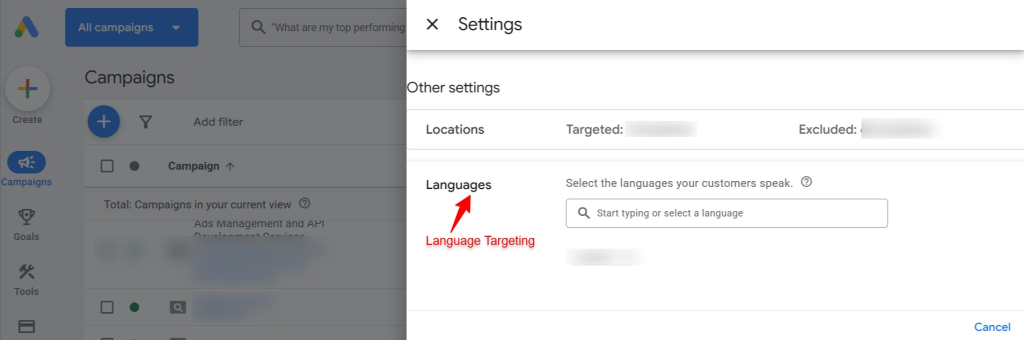
In Google Ads, language targeting has traditionally been a manual, campaign-level setting. Advertisers selected the languages they wanted to target, and Google used those settings to determine which users could see their ads.
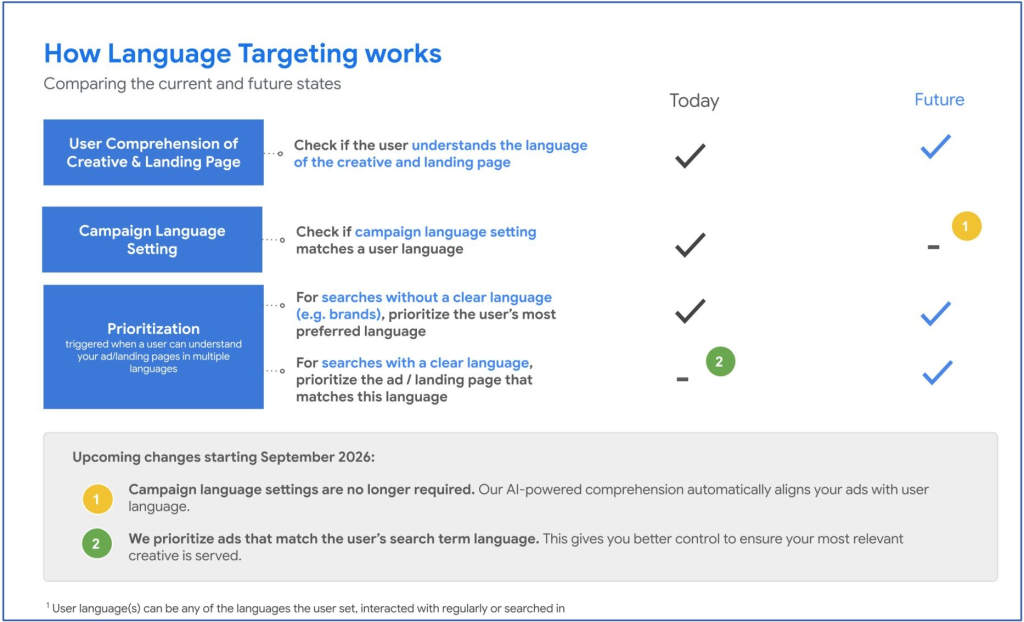
Now, that’s changing as Google moves toward using AI to determine which ad is the best match for each search. Instead of relying on manually selected language settings, Google can consider the language of the user’s search, the languages of the available ads and landing pages, and other user signals to determine the most relevant experience.
For example, if an advertiser has ads and landing pages in both English and German, Google can look at the language of the user’s search, the available ad and landing page languages, and other user signals to determine which experience is most relevant.
So, what is actually changing, and what is not?
What is Changing?
- The manual language targeting setting is being removed.
- Google’s AI evaluates relevance across eligible ad groups to decide which one enters the auction.
What is Staying the Same?
- Language exclusions still work as before
- Google still will not translate ads, including in AI Max
- Cross-language matching can show ads for queries in another language if Google believes the user understands it.
- Single-language account structures will continue to function
What Does It Mean For Advertisers?
For advertisers, this change marks an important shift because it shows how Google wants advertisers to think about targeting. Here are a few points to consider:
1. Language transformed into an AI-driven signal
Earlier, language targeting was a clear campaign-level setting. Now, Google determines language relevance using a combination of different signals.
2. Less manual control
Advertisers are moving from choosing exactly who to target to giving Google signals and letting AI find the right audience. Ad copy, landing pages, keywords, search themes, and other campaign inputs are becoming more important because they give Google a clearer picture of what an advertiser is offering and who it’s relevant to.
3. No urgent restructuring needed
Advertisers don’t have to merge campaigns just because language targeting is being removed. If campaigns have different budgets, products, messages, markets, or goals, it may still make sense to keep them separate.
What Is The Next Step Then?
According to Google’s latest official guidance, most advertisers don’t need to take any immediate action for their existing campaigns. However, some advertisers may need to consider the following:
- Review campaign structure, especially for multilingual campaigns
- Monitor performance after the rollout
For API users, Google recommends leaving out language criteria when creating or updating Search campaigns through Google Ads API requests. For existing campaigns, advertisers can remove language targeting if they want to keep their account clean, although it will no longer have any effect.
How Does Karooya See This Announcement?
As per Karooya, this change could be part of Google’s broader shift towards AI-driven matching and optimisation. As Google increasingly decides which searches are relevant to users, advertisers may gradually have less control over some targeting settings.
For advertisers running multilingual campaigns, this change could have a more noticeable impact. For others, it may simply mean keeping a closer eye on search traffic to spot any unexpected changes.
One area worth watching is search terms. As Google relies more heavily on AI to determine which searches match an ad, advertisers may need to regularly review their search-term data and identify queries that don’t align with their business goals. This is where Karooya’s Negative Keywords Tool could potentially help. By analysing search-term data and identifying irrelevant queries, the tool can help advertisers find potential negative keywords and reduce unwanted traffic.
The full impact of the change will likely become clearer as it rolls out and advertisers have enough data to compare performance before and after the update. In the meantime, keeping an eye on the traffic generated through Google’s automation may be just as important as reviewing the targeting settings advertisers choose.
Related Links


Stop the wasted ad spend. Get more conversions from the same ad budget.
Our customers save over $16 Million per year on Google and Amazon Ads.