

For years, the search and content industry has argued over how much traffic Google’s AI Overviews (AIOs) are actually siphoning from websites. Google has downplayed it. Publishers have pointed to steep traffic declines. SEO tools have published observational data. But nobody had causal proof — until now.
A new field experiment from researchers at the Indian School of Business and Carnegie Mellon University (Agarwal & Sen, 2026) finally isolates the cause-and-effect relationship, and the numbers are stark.
TL;DR
- Researchers ran a real randomized experiment (not just before/after observation) using a Chrome extension that secretly hid AI Overviews (AIOs) for one group of 1,000+ Google users while showing them normally to another.
- When an AIO would have appeared, hiding it increased organic clicks by 39.8% and cut zero-click searches by 34.5%.
- Sponsored (ad) clicks were unaffected — the damage is concentrated in organic, not paid.
- The “extra” clicks recovered by hiding AIOs were just as high-quality as normal clicks (same bounce rate, same time on site) — debunking the idea that AIOs only eat low-value traffic.
- AIOs didn’t increase how often people search overall. No extra sessions, no offsetting search volume — the effect is a pure transfer of clicks away from organic results, not a net gain in search activity.
- User satisfaction was identical whether AIOs were shown or hidden — so AIOs aren’t measurably improving the search experience either.
- A more AI-forward “AI Mode” condition showed even steeper traffic loss and lower user satisfaction, suggesting the problem gets worse, not better, as AI search interfaces evolve.
- This is now real causal evidence, not industry anecdote — likely to show up in ongoing antitrust and regulatory discussions in the UK, EU, and US.
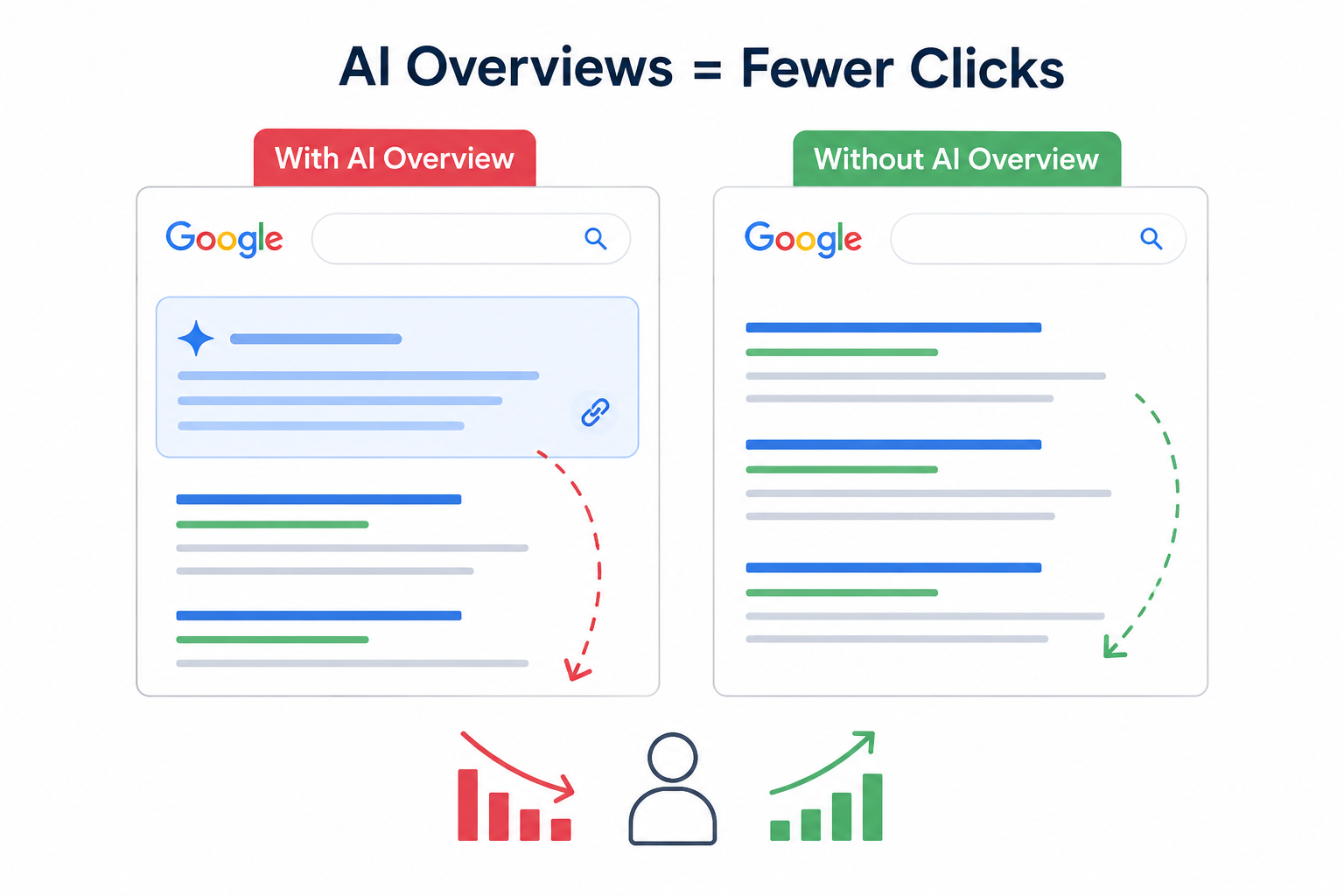
Key Finding #1: AIOs Cut Organic Clicks by ~40%
When an AIO was triggered (or would have been triggered), removing it changed behavior sharply:
| Metric | AIO Shown (Control) | AIO Hidden (HAIO) | Change |
|---|---|---|---|
| Organic clicks per search | 0.37 | 0.62 | +39.8% |
| Zero-click search rate | 73% | 54% | −34.5% |
| Sponsored clicks per search | 0.02 | 0.02 | No change |
As stated in the document:
“AIOs reduce outbound organic clicks by 39.8% and increase zero-click searches by 34.5%, without affecting sponsored clicks or overall search frequency.”
What this means: AIOs aren’t just nudging behavior at the margins — they’re roughly halving the odds that a triggering query sends any traffic downstream at all. And notably, paid clicks held steady across all conditions — this is squarely an organic/content traffic problem, not (yet) a paid search volume problem.
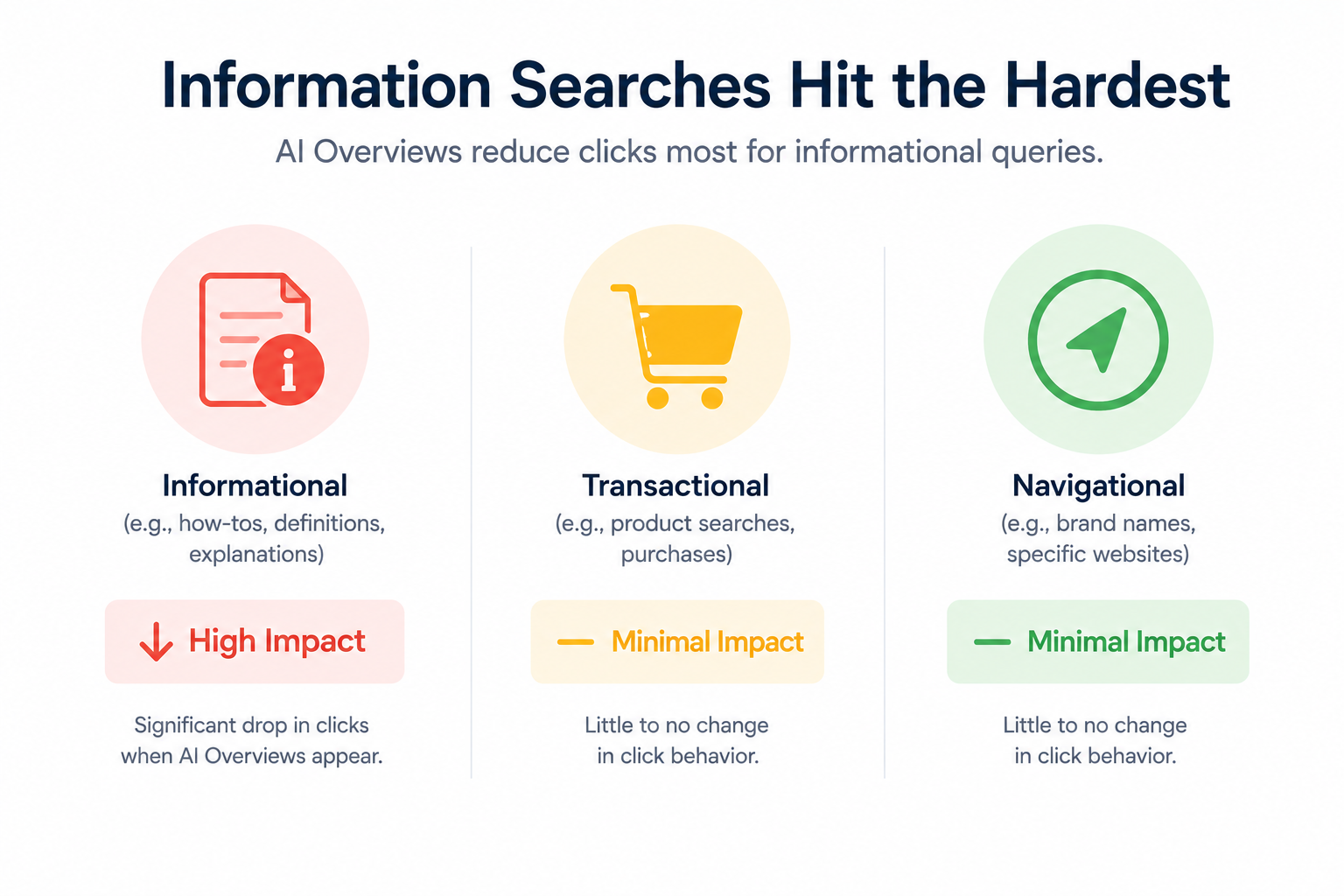
Why this matters specifically for paid search: Two pieces of this study reinforce each other here. First, sponsored clicks were flat (0.02 vs 0.02) regardless of whether the AIO was shown or hidden — hiding the AIO recovered organic clicks, but didn’t touch paid click volume at all. Second, when the researchers broke results down by query intent, transactional queries — the purchase-intent searches where paid ads compete hardest — showed no statistically significant change in organic clicks either, unlike informational queries where the effect was large and significant. Put together: the AIO effect documented in this study is concentrated in informational, top-of-funnel search behavior, not in the commercial, bottom-of-funnel queries that paid search campaigns are typically built around. For now, that’s a reassuring signal for PPC specifically — but it’s also the exact area worth monitoring, since it’s the one place where an expanding AI-mediated SERP could eventually start competing directly with paid placements (see “Next Steps,” item 2).
Key Finding #2: It’s About Position, Not Just Presence
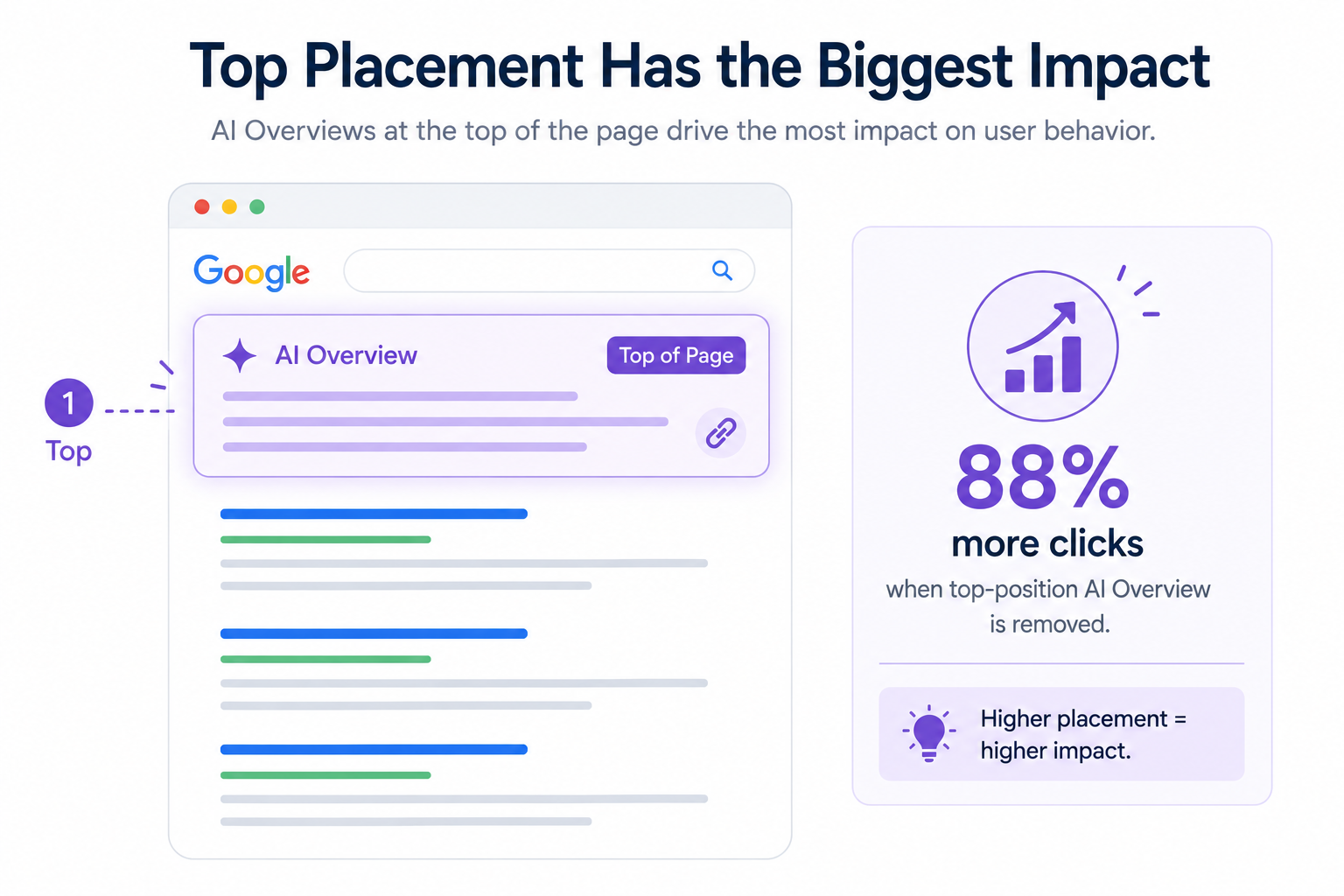
The effect wasn’t uniform — it was almost entirely driven by where the AIO sat on the page.
- “More than 87% of triggering queries display the AIO at the very top of the page, above all organic results.”
- When the AIO appeared at the top: removing it produced an 88% increase in organic clicks.
- When the AIO appeared lower on the page: there was no meaningful effect on click behavior.
- Within organic results, the recovered clicks were concentrated at position #1, tapering off quickly by position 3 and beyond.
What this means: This isn’t really about AI summaries being “better” at answering queries. It’s about real estate. The AIO occupies the most valuable pixels on the page, and users click what they see first — a dynamic well established in click-position research even before generative AI entered the picture.
Key Finding #3: The Lost Clicks Weren’t Low-Quality Clicks
This is arguably the most important finding for anyone trying to have this conversation with a skeptical stakeholder — because it directly contradicts a claim Google has made publicly.
Google has suggested AIOs mostly eliminate low-value clicks that would have bounced anyway. This study tested that claim directly by measuring bounce rate, time-on-site, and “back to search” behavior for the additional clicks recovered when AIOs were hidden. It found no meaningful difference on any of these measures between the two groups.
“The absence of meaningful differences in bounce rates and time spent on downstream websites suggests that the additional clicks generated by HAIO are comparable in quality to those observed in the control group. This finding is at odds with the view that AIOs primarily eliminate low-engagement website visits.”
What this means: The traffic AIOs are diverting is not junk. It’s traffic that would have engaged with the destination site just as much as any other visit. There’s no quality offset to justify the volume loss.
Key Finding #4: AI Overviews Didn’t Increase Search Activity
One theory worth ruling out: maybe AIOs make search so convenient that people just search more overall, offsetting any per-search click loss with extra search volume. The study tested this directly by comparing the total number of searches per user between the Control and HAIO groups — and found no meaningful difference.
The researchers frame it this way:
“We find no change in the number of searches that users make in the HAIO and control groups, implying that the reduction in clicks per search translates into a meaningful decline in overall outbound web traffic.
They also confirm this holds at the user level, not just user-day level, and describe the mechanism plainly:
“These findings suggest that the effects of AIOs operate primarily through the intensive rather than the extensive margin.”
What this means: AIOs aren’t generating new search demand or extra sessions to compensate publishers elsewhere. People conduct the same number of searches whether or not an AIO shows up — they just click through to fewer sites per search when it does. There’s no volume-side silver lining here: this is a pure transfer of clicks away from organic results, not a net-positive shift in overall search activity that publishers could hope to capture through some other query.
Key Finding #5: AI Mode Is a Bigger Cliff, Not a Smaller One
So far, every finding above compares two versions of the same search results page — one with an AI Overview box at the top, one without. AI Mode is a different thing entirely: instead of a results page with links, Google replaces the whole search experience with a chatbot-style conversation. There’s no list of blue links to scroll past — just an AI-generated answer, with a box to type a follow-up question.
The study put a third group of users into this AI Mode experience for every search, and compared their behavior to the normal Control group (standard search, AI Overview shown as usual):
| Metric | Standard Search (Control) | AI Mode |
|---|---|---|
| External clicks per search | 0.53 | 0.36 (32% fewer clicks) |
| Zero-click rate | 59% | 70% (+11 points) |
| User satisfaction (out of 5) | 4.0 | 2.9 (significantly lower) |
One important caveat: a lot of people dropped out of the AI Mode group during the study — far more than in the other two groups — because it was such a big change from normal search. That means this comparison isn’t as rock-solid as the main AIO-vs-no-AIO result above; the researchers call it “exploratory,” not causal. It’s also worth noting this likely makes AI Mode look better than it really is: the people who stuck around are probably the ones who tolerated it best, while people who hated it most likely quit early and dropped out of the results entirely.
Even accounting for that, the direction is a clear warning sign: unlike a simple AI Overview box, which recovers organic clicks the moment you hide it, AI Mode drives traffic down and drives satisfaction down at the same time — there’s no user-experience upside to offset the traffic loss.
What this means: An AI Overview sits on top of a normal results page and can be turned off without changing anything else. AI Mode replaces the page entirely. If Google pushes more search volume toward AI Mode-style experiences over time, the traffic decline publishers are seeing from AI Overviews today could turn out to be the smaller problem, not the main one.
What This Study Means for the Industry
Put together, the study’s conclusion is :
“Though AI integration can streamline access to information, it may simultaneously undermine the economic incentives that sustain high-quality content production.”
This isn’t just an academic point. It has three concrete implications:
- It’s now harder for platforms to argue AIOs are traffic-neutral or quality-improving. This is causal, pre-registered, IRB-approved experimental evidence — a different tier of proof than survey data or SEO-tool click studies. Expect it to get cited in regulatory conversations already underway in the UK, EU, and US.
- The problem is currently organic-specific, but that could shift. Paid clicks were flat throughout this study. That’s good news for advertisers today, but the AI Mode data suggests the ceiling on “how much of the SERP can AI intermediate” hasn’t been reached yet.
- Content economics, not just SEO tactics, are at stake. If referral traffic — the thing that funds subscription and ad-supported content models — keeps eroding without any offsetting quality signal, the study’s authors argue this could affect the quantity and quality of content produced going forward. That has second-order effects on everyone who depends on a healthy content ecosystem, including advertisers who need something to advertise against.
Next Steps for Paid Search Practitioners
1. Re-audit your channel mix assumptions. If organic is losing ~40% of clicks on AIO-triggering, top-of-funnel queries, any plan that assumes organic will “pick up the slack” for informational intent is now on shakier ground. Revisit blended funnel models, especially for queries the study found are informational in nature — “Informational queries make up 71% of all searches and have the highest AIO trigger rate (53%)” of the three intent categories studied.
2. Watch for encroachment into paid, even though this study didn’t find it yet. Sponsored clicks were flat here — but this was measured in a two-week window in a single AIO/AI Mode configuration. As AI Mode usage grows and as Google experiments with commercial integrations inside conversational search, monitor CTR and impression share trends closely rather than assuming the wall between “AI answers” and “paid results” is permanent.
3. Tighten what you can control: query-level precision. With less organic real estate acting as a backstop, wasted spend on loosely-matched or irrelevant search terms becomes costlier — there’s less of a safety net catching the traffic you didn’t bid well for. Regular negative keyword hygiene becomes more valuable, not less, in this environment.
4. Protect your own search term history. This study had to reconstruct search-level behavior almost forensically — matching clicks to sessions, discarding ambiguous states — because platforms don’t offer clean, durable visibility into search behavior by default. As more discovery shifts behind AI layers you don’t have visibility into, retaining your own historical search term and query data (rather than relying entirely on what the platform’s own reporting surfaces) becomes a bigger part of defending performance over time.
5. Bring this data into stakeholder conversations. If you’ve been asked to justify budget shifts or explain declining organic-assisted conversions, this study gives you a credible, non-anecdotal number to point to — 39.8% is a specific, citable, peer-reviewed-adjacent figure, not a vibe.
Caution Note: What to Be Careful About, and How to Prepare
A few reasons to rethink not to over-apply this data:
- It’s a narrow sample. US users only, desktop only, Chrome only, over two weeks in Jan–Feb 2026. Mobile, other browsers, other countries, or longer time periods might look different. Treat 39.8% as a strong signal of direction, not a fixed number to plug into your own forecasts.
- The AI Mode numbers are weaker evidence than the main AIO numbers. Many people dropped out of that group during the study, which the researchers say “limits causal interpretation in this arm.” The direction (worse traffic, worse satisfaction) is a useful warning sign, but don’t treat it with the same confidence as the main AIO-vs-no-AIO result.
- Your own exposure to AIOs may be very different. This study found AIOs on 41% of queries. Other research cited in the paper found 67% on a different query set. So check your own numbers — how often AIOs show up on your target keywords — instead of assuming this study’s rate applies to you.
- More clicks isn’t automatically more revenue. This study measured clicks and engagement (bounce rate, time on site), not sales or conversions. A recovered click that looks “high quality” by these measures still needs to convert to matter for your business.
- How to prepare: Don’t wait on regulators to act — none of the antitrust or opt-out proposals mentioned in the paper (UK, EU, Brazil) have concluded yet. Instead, start tracking things yourself: how often AIOs appear on your key queries, how your organic traffic trends over time, and whether AI Mode-style interfaces start showing up more in your own traffic data. If a large share of your traffic strategy depends on organic rankings for informational content specifically, treat that as a concentrated risk — this is the exact traffic type the study shows shrinking — and look at diversifying into paid, other content formats, or other channels rather than relying on it as your primary growth lever.
Related Links:
Stop the wasted ad spend. Get more conversions from the same ad budget.
Our customers save over $16 Million per year on Google and Amazon Ads.