

Can advertisers bid on a competitor’s trademark in Google Ads? This question has been at the center of multiple legal battles in India over the past decade. Courts have examined whether using trademarks as keywords amounts to infringement, whether Google can be held liable for allowing such bidding, and how trademark rights should be balanced against online advertising practices.
The legal position has evolved significantly over time, with courts arriving at different conclusions depending on the facts, the trademark involved, and the role played by Google.
Here’s a chronological look at the most important trademark bidding cases in India and where each stands today.
1. BharatMatrimony vs Google (Consim Info Pvt. Ltd.)
Court: Madras High Court
Period: 2012–2017
Status: Concluded
The Dispute
Consim Info, operator of BharatMatrimony and other matrimonial portals, alleged that competitors were bidding on its trademarks through Google AdWords.
The company argued that Google was facilitating trademark infringement by allowing advertisers to purchase registered trademarks as keywords.
Why It Matters
This was one of the first major Indian cases to examine Google’s AdWords system in detail, including:
- Keyword auctions
- Keyword suggestion tools
- Trademark use in search advertising
Outcome
The Madras High Court did not completely prohibit keyword bidding but examined Google’s role in facilitating such advertising and laid the foundation for future litigation involving trademarked keywords. The case became an important reference point in subsequent disputes involving Google Ads and trademarks.
Key Takeaway
The case established that keyword advertising could be scrutinized under trademark law and opened the door for future challenges against Google’s advertising practices.
2. DRS Logistics (Agarwal Packers & Movers) vs Google
Court: Delhi High Court
Decision: 2021
Status: Concluded
The Dispute
DRS Logistics, owner of the well-known “Agarwal Packers & Movers” brand, challenged Google’s practice of allowing competitors to bid on its trademark.
Outcome
The Delhi High Court Division Bench held that the mere use of a trademark as a keyword does not automatically constitute trademark infringement.
The Court distinguished between:
- Use of a trademark as a visible brand identifier
- Use of a trademark as an invisible keyword trigger
The judgment became Google’s strongest precedent in India on keyword bidding.
Key Takeaway
The Court effectively held that keyword bidding, by itself, is not necessarily infringement and must be evaluated in the context of consumer confusion, unfair advantage, and the specific facts of the case.
3. MakeMyTrip vs Booking.com & Google (Single Judge)
Court: Delhi High Court
Decision: April 2022
Status: Overturned on Appeal
The Dispute
MakeMyTrip alleged that Booking.com was bidding on the trademarks “MakeMyTrip” and “MMT” through Google Ads.
The company argued that competitors were benefiting from its brand goodwill and diverting users searching specifically for MakeMyTrip.
Outcome
The Single Judge agreed with MakeMyTrip’s arguments and granted interim relief.
The Court observed that the use of a competitor’s trademark as a keyword could amount to trademark infringement because it leveraged the trademark owner’s goodwill and diverted traffic.
Key Takeaway
For a brief period, the ruling suggested that competitor keyword bidding could be treated as trademark infringement in India.
4. Google & Booking.com vs MakeMyTrip (Division Bench)
Court: Delhi High Court Division Bench
Decision: December 2023
Status: Concluded
The Appeal
Google and Booking.com challenged the Single Judge’s order.
Outcome
The Division Bench reversed the earlier ruling and delivered a significant victory for Google.
The Court held that:
- Use of trademarks as keywords is not automatically infringement.
- Keywords are not equivalent to visible trademark use.
- Consumer confusion and unfair advantage must be established.
- Mere bidding on a trademarked keyword is insufficient to prove infringement.
The Court relied heavily on the reasoning adopted in the DRS Logistics decision.
Key Takeaway
This judgment reinforced Google’s position that trademark keyword bidding is generally permissible unless additional factors establish infringement.
5. MakeMyTrip’s Supreme Court Challenge
Court: Supreme Court of India
Decision: March 2024
Status: Concluded
The Appeal
MakeMyTrip challenged the Delhi High Court Division Bench ruling before the Supreme Court.
Outcome
The Supreme Court declined to interfere with the Delhi High Court’s decision.
As a result, the Division Bench ruling remained in force, and Google effectively retained its legal victory regarding the use of trademarks as keywords.
Key Takeaway
Following the Supreme Court’s refusal to intervene, the prevailing legal position appeared to favor Google’s trademark keyword bidding model.
6. Hindware vs Google
Court: Delhi High Court
Decision: May 2026
Status: Recently Decided (appeal possible)
The Dispute
Hindware discovered that competitors were bidding on its registered trademark “HINDWARE” through Google Ads.
The company argued that:
- Competitors were exploiting its brand goodwill.
- Consumers searching for Hindware were being diverted.
- Google was actively facilitating and profiting from the practice.
Outcome
In a landmark ruling, the Delhi High Court ruled in favor of Hindware.
The Court:
- Restrained Google from using “HINDWARE” as an advertising keyword.
- Awarded ₹30 lakh in damages.
- Rejected Google’s intermediary defense.
- Held that even invisible keyword use can constitute trademark use in advertising.
Why This Case Is Different
Google relied on the MakeMyTrip line of cases during its defense.
However, the Court distinguished Hindware from MakeMyTrip by emphasizing that HINDWARE is a coined and inherently distinctive trademark, unlike marks formed from common dictionary words. Searches for “HINDWARE” therefore reflected stronger brand-specific intent and deserved greater protection.
Key Takeaway
The judgment signals that courts may be willing to provide stronger protection for highly distinctive trademarks and may scrutinize Google’s role more closely when trademarked keywords are monetized.
Evolution of India’s Trademark Bidding Jurisprudence
| Year | Case | Outcome |
|---|---|---|
| 2012–2017 | BharatMatrimony vs Google | First major challenge to Google’s keyword advertising practices |
| 2021 | DRS Logistics vs Google | Keyword use not automatically infringement |
| 2022 | MakeMyTrip vs Booking.com (Single Judge) | Trademark owner receives injunction |
| 2023 | Google vs MakeMyTrip (Division Bench) | Injunction overturned; Google wins |
| 2024 | MakeMyTrip Supreme Court Appeal | Supreme Court declines intervention |
| 2026 | Hindware vs Google | Google held liable; keyword use treated as infringement |
Final Thoughts
The journey of trademark bidding litigation in India shows that there is no single rule that applies to every trademark.
The early trend, reflected in DRS Logistics and the final MakeMyTrip outcome, suggested that keyword bidding was generally permissible. However, the Hindware judgment introduces a new dimension by focusing on the distinctiveness of the trademark, the commercial exploitation of brand goodwill, and Google’s active role in monetizing trademarked searches.
Whether Hindware becomes the new benchmark or is revisited by appellate courts remains to be seen. For now, it stands as the most significant Indian ruling in favor of trademark owners in the ongoing debate over competitor keyword bidding.
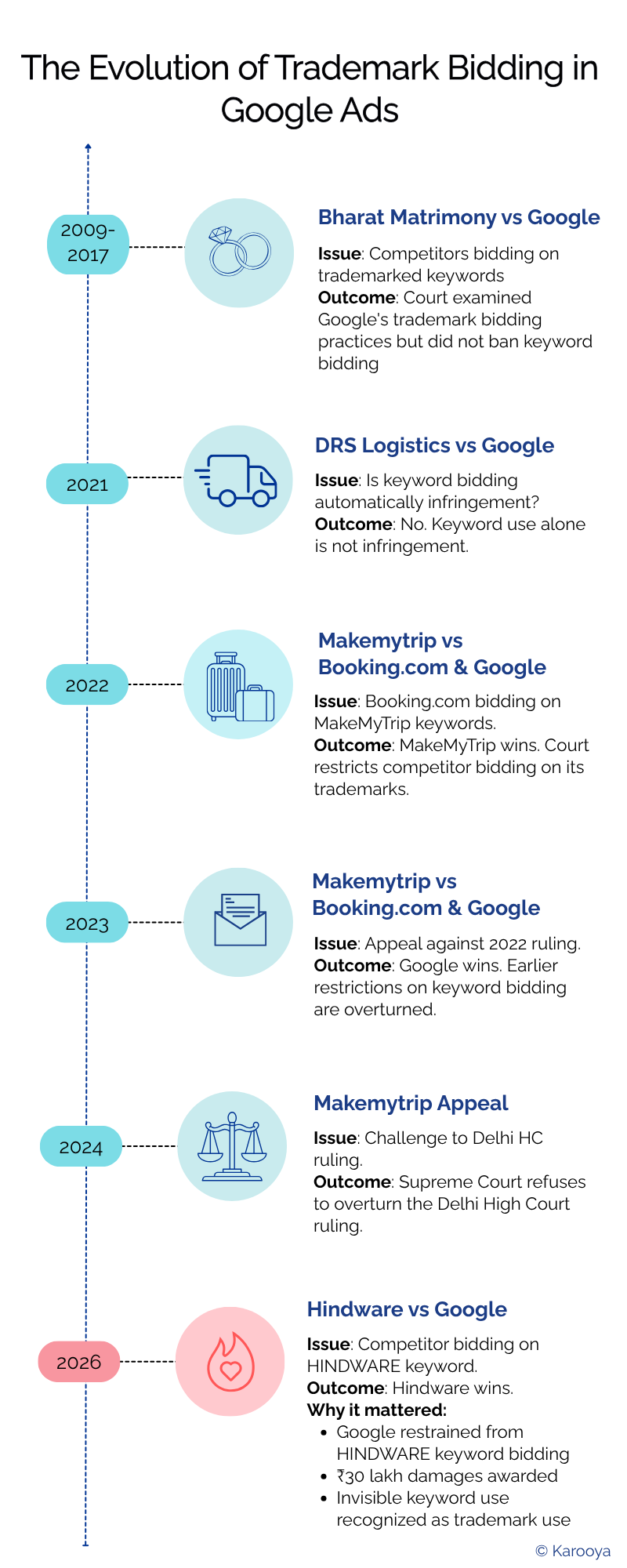
From BharatMatrimony to Hindware: The Trademark Bidding Timeline
The infographic below summarizes the key trademark bidding cases that have shaped Google’s advertising policies in India over the years. From the early BharatMatrimony litigation to the recent Hindware ruling, these cases highlight how courts have interpreted competitor keyword bidding, Google’s role in facilitating such advertising, and the extent of trademark protection in search ads. Together, they illustrate the evolution of Indian jurisprudence on trademark bidding and why the Hindware judgment is being viewed as a potentially significant shift in how courts assess the use of trademarks as advertising keywords.



Stop the wasted ad spend. Get more conversions from the same ad budget.
Our customers save over $16 Million per year on Google and Amazon Ads.