

Your affiliate traffic just got more expensive to replace. Amazon cut affiliate payouts sharply this year — which means your ad spend now has to cover what ground affiliates used to cover for free.
TL;DR
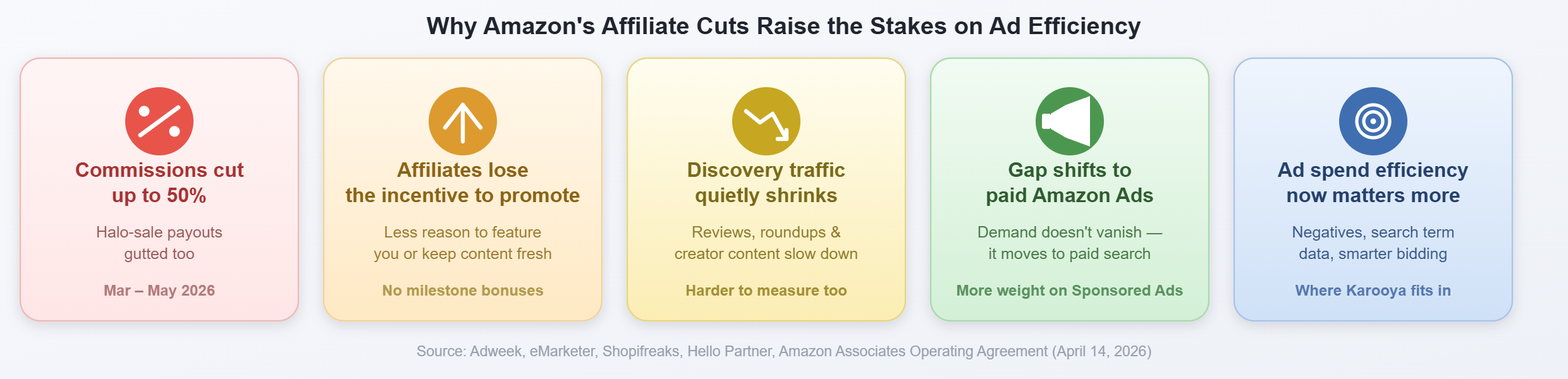
Between March and May 2026, Amazon quietly cut affiliate commission rates by up to 50%, eliminated milestone bonuses, and reduced the “halo sale” commissions that let affiliates earn on unrelated cart purchases. Amazon never announced this publicly — publishers found out through their account managers. For brands, the practical effect is a shrinking, less reliable affiliate/creator channel. That traffic gap doesn’t close itself. It gets absorbed by paid search — which means Amazon Ads efficiency now carries more weight than it did a year ago.
Our take on what this means
Affiliates are earning less and have lost the bonuses that rewarded extra volume, so many have less reason to keep featuring or promoting your products. That shrinks the free discovery traffic brands got from reviews and roundups — but the underlying demand doesn’t disappear, it shifts to paid channels, mainly Amazon Ads (worth noting, if only in passing, that Amazon’s own paid placements happen to be the beneficiary of that shift). That means ad spend now has to cover more of the work affiliates used to do partly for free, which raises the stakes on how efficiently it’s managed. This is our read on a plausible, connected shift, not a claim that PPC tools fix affiliate economics.
What changed
Amazon’s Associates Program Operating Agreement was updated on April 14, 2026. None of this was formally announced — it surfaced through reporting from Adweek, later confirmed by eMarketer, Shopifreaks, and Hello Partner, based on conversations publishers had with their own Amazon account managers.
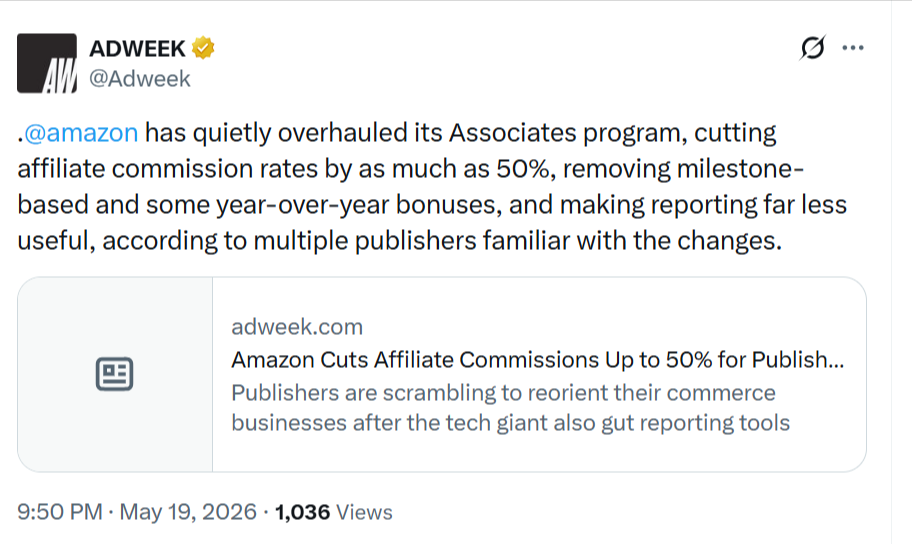
- Commission rate cuts (APAC late 2025 → US ~March 9, 2026). Up to 50% lower in some categories; premium categories fell from ~10% to 4–5%. Not uniform — long-standing publishers kept better terms. Adweek · eMarketer
- Milestone bonuses eliminated. Volume-based rate boosts and YoY performance bonuses removed for most partners. eMarketer
- Reporting stripped down. Higher threshold for tracking-ID data, SKU/ASIN-level reporting removed, some premium API access revoked. eMarketer
- New Associates Operating Agreement, effective April 14, 2026 — the one officially dated change, not anonymously sourced. Ended halo-sale commissions (no longer paid on the rest of a shopper’s cart, only the referred item), added a 180-day shipping window affecting pre-order commissions, disqualified certain boosted-post purchases, and required original commentary on linking pages. Thrive with Carrie
What this means if your brand leans on affiliates
If part of your product discovery has historically come from creators, review sites, or “best of” roundups, three things are worth checking right now:
- Are your affiliate partners still incentivized to feature you? Lower commissions and no milestone bonuses mean less reason for a publisher to prioritize your product over a competitor’s — or to keep the content updated at all.
- Were you benefiting from halo sales you never tracked? If customers were discovering your product as an add-on purchase inside someone else’s affiliate cart, that lift is shrinking and you likely never had visibility into it in the first place.
- Is your affiliate-driven traffic actually declining, or just less measurable? The reporting cuts mean some brands will see softer numbers without a clear cause — it may be less traffic, or it may just be less data.
None of this is a reason to panic. It’s a reason to check whether the top-of-funnel discovery you were counting on is still doing the job it used to.
Where paid search fits in
The affiliate channel isn’t disappearing, but it’s smaller and less predictable than it was in early 2026. For most brands, the traffic gap gets filled — deliberately or not — by Amazon Ads. That’s a reasonable shift, but it only works if the ad spend is actually efficient, because you’re now asking paid traffic to do work that used to come partly for free.
A few areas worth tightening if you’re increasing reliance on ads to offset affiliate softness:
- Negative keywords and search term hygiene. If you’re spending more to compensate for lost organic/affiliate discovery, wasted spend on irrelevant search terms costs more than it used to.
- Search term archival. Amazon only retains search term reports for 60 days. If you’re trying to understand which queries are now converting in the absence of affiliate-driven discovery, you need history beyond that window to spot trends.
- Dayparting and portfolio-level bidding. With more of your acquisition budget riding on ads, timing and bid discipline matter more than when affiliates were covering part of the funnel.
We’re not going to claim a PPC tool fixes affiliate economics — it doesn’t. But if affiliate traffic is contracting and your ad spend has to pick up more of the load, the tools you use to keep that spend clean and well-targeted matter more than they did a year ago. That’s the case for treating your search term data and negative keyword management as more than routine maintenance right now.
Frequently asked questions
Has Amazon officially confirmed these changes?
Not with a public announcement or press release. Amazon updated the Associates Operating Agreement itself (effective April 14, 2026), which is a primary, checkable source, but the commission-rate cuts and reporting reductions were surfaced through publishers describing conversations with their account managers, not through a company statement. Treat the operating agreement language as confirmed policy, and the specific percentage figures as well-sourced but publisher-reported.
Does this affect every affiliate and every category the same way?
No. Multiple sources note the cuts weren’t applied uniformly — publishers with longstanding Amazon relationships kept more favorable terms, while paid-media-driven affiliate businesses and high-volume review sites were hit hardest. Category matters too: premium categories saw the steepest cuts (roughly 10% down to 4-5%), while others were less affected.
Is this the same thing as the Amazon Influencer Program?
They overlap but aren’t identical. Associates covers link-based affiliates (bloggers, review sites, deal sites); the Influencer Program covers creators posting shoppable video/photo content. Reporting suggests both are affected by the halo-sale and reporting changes, but the “original content” rule tightening is described specifically in the context of Associates-linked blog and review content.
Does this affect our Amazon Ads / PPC spend directly?
Not directly — these changes are specific to the Associates affiliate program’s commission structure, not to Sponsored Products, Sponsored Brands, or Sponsored Display. The connection is indirect: if affiliate-driven discovery traffic shrinks, brands that relied on it may see softer organic/assisted conversions and need ads to cover more of the funnel.
Should we stop working with affiliates altogether?
That’s not what this data supports. Affiliate-driven retail ecommerce sales are still forecast to grow through 2029 — the channel isn’t dying, it’s getting less generous for affiliates and harder to measure. The more useful question for a brand is whether your current affiliate partners are still motivated under the new economics, not whether to exit the channel entirely.
How do we know if we were benefiting from “halo sales” we never tracked?
Practically, you may not have precise visibility — that’s part of what makes this change hard to quantify. If you sell complementary or multi-SKU product lines and previously saw a broad base of “best of” or gift-guide affiliate content pointing to a hero product, some of your cart-adjacent SKU sales may have been affiliate-attributed halo purchases. Reporting cuts on the affiliate side make this harder to isolate going forward, which is itself part of the story.
Are more cuts coming?
Unknown — this is a live, unfolding situation and publishers are still adjusting. If you’re building this into planning, it’s worth treating “affiliate economics keep getting less predictable” as the durable trend rather than betting on rates stabilizing or reversing.
What are affiliates doing in response?
Reporting and community discussion (including Reddit threads referenced above) point to publishers diversifying toward Walmart, TikTok Shop, and direct e-commerce partnerships, and comparing platforms on data quality and payout economics rather than defaulting to Amazon.
Useful Reads
The story broke through trade press first, then spread into creator and affiliate-community discussion. Worth reading a few different angles rather than just one summary:
- Adweek — “Amazon Cuts Affiliate Commissions Up to 50% for Publishers” (May 18, 2026) — The original reporting, based on interviews with seven publishers and partners. Notes the changes began rolling out in Asia-Pacific in late 2025 before reaching the U.S. around March 9, 2026.
- eMarketer — “Amazon cuts affiliate commissions by up to 50%, raising pressure on publishers” (May 19, 2026) — Adds useful market context: affiliate-driven retail ecommerce sales are still forecast to grow from $180.89 billion in 2026 to $231.53 billion in 2029, which sharpens the disconnect between affiliates’ rising influence on purchases and Amazon paying less for that traffic.
- Hello Partner — “Affiliates Face Financial Shock as Amazon’s Associates Programme Cuts Commission Rates” (May 20, 2026) — UK-focused trade coverage, notes the cuts weren’t applied uniformly across all publishers.
- Shopifreaks — “Amazon Slashed Affiliate Commission Rates by up to 50% and Gutted Reporting Tools” (May 25, 2026) — Includes the Andrew Perlman quote above and frames the shift as an opening for Walmart and TikTok Shop to court disaffected affiliates.
- January Digital — “Amazon Affiliate Commission Cuts 2026 Explained” — A brand-side (not affiliate-side) read on the same changes, arguing the halo-sale compression hits influencer/video creators hardest while milestone-bonus removal hits large content publishers hardest — different pain points depending on business model.
- Affiliyo — “Amazon Associates April 2026 Policy: What Changed, What to Fix” — The most granular breakdown of the three policy mechanics (180-day window, halo compression, original-content rule), useful if you want the “how it actually works” detail rather than the topline numbers.
- Affiverse Media — “Reddit Threads Show Publishers Rethinking Amazon Associates” — A look at how affiliates are actually discussing this among themselves: some are openly comparing Amazon against alternatives on category fit, data quality, and payout economics rather than treating Amazon as the automatic default.
- Amazon Associates Central — official Operating Agreement update — The primary source. Confirms the April 14, 2026 effective date and the exact policy language for the 180-day qualifying window, narrowed onsite commission scope, and the new “original content” definition.


Stop the wasted ad spend. Get more conversions from the same ad budget.
Our customers save over $16 Million per year on Google and Amazon Ads.