

Amazon advertisers are used to thinking about CPCs, bids, ROAS and auction competition. But a new lawsuit filed by the U.S. Federal Trade Commission (FTC) could put a much bigger question on the table: Do advertisers actually pay what Amazon’s advertising auction says they should pay?
TL;DR: On August 31, 2026, the FTC and 22 states sued Amazon, alleging that Amazon secretly altered the way its advertising auctions determined prices and charged advertisers hidden surcharges. According to the complaint, Amazon continued representing its Sponsored Ads auctions as generalized second-price (GSP) auctions while allegedly using an undisclosed pricing mechanism that could push the final CPC above the price generated by advertiser competition.
For advertisers, the distinction matters. Auction mechanics don’t just determine what you pay today—they influence how you set bids, forecast advertising costs and decide how aggressively to compete for placements.
Here’s what the lawsuit alleges, what it could mean for Amazon advertisers, and how Amazon is responding.
1. A Quick Refresher: How the Auction Is Supposed to Work
Since you already run campaigns, you know the basics — but here’s the specific mechanism at the center of this case, since it’s the whole ballgame.
Amazon has told advertisers for years that Sponsored Products, Sponsored Brands, and Display auctions use a generalized second-price (GSP) auction — the same auction model that’s been the industry standard since early Google/search advertising:
- Advertisers submit bids on keywords/placements.
- Amazon ranks bids by a mix of the bid amount and a relevance score (predicted click-through rate and conversion likelihood).
- The highest-ranked bidder wins, but instead of paying their own bid, they pay just enough to beat the next-highest bidder — classically illustrated as “a penny more than the second-place bid.”
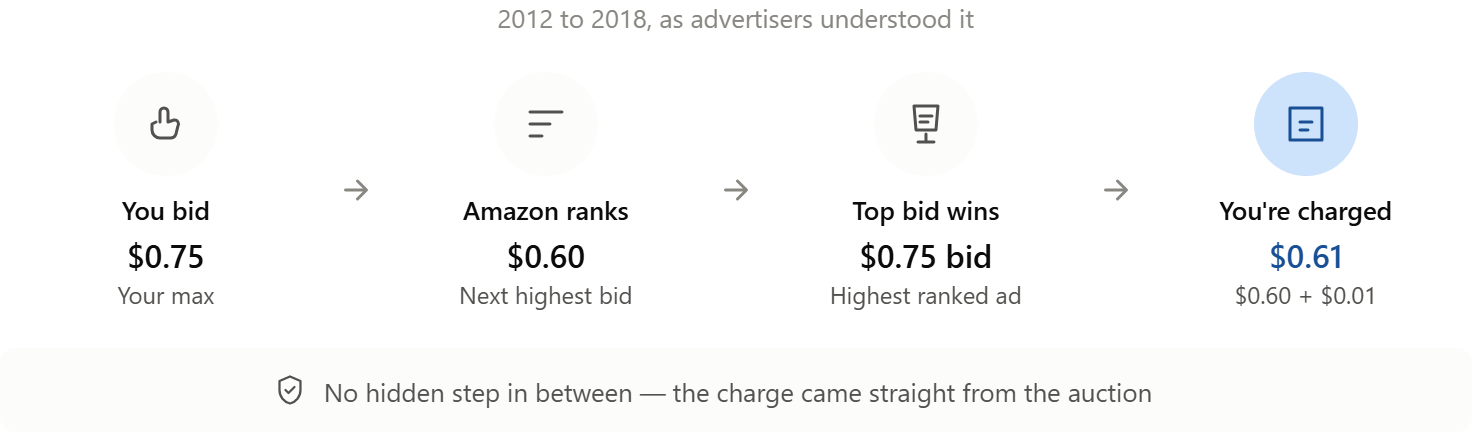
The whole appeal of this model, and the reason advertisers are comfortable bidding aggressively (or letting Amazon’s automated bidding push bids up 100–900% via dynamic/rule-based bidding), is the promise that you’ll never actually pay your full bid — the market, not Amazon, sets your price.
2. The Core Allegation: A Hidden Second Step After the Auction
According to the complaint, Amazon began calculating prices in two stages, starting with Sponsored Brands in 2018 and expanding to Sponsored Products in 2019 and Display Ads by 2023:
- Stage 1 — Run the real GSP auction. Amazon determines the winner and calculates the “GSP CPC” — the price the auction actually produced.
- Stage 2 — Apply a “soft reserve.” Amazon then calculates a second, higher number internally and replaces the GSP CPC with it. That became the advertiser’s actual charged CPC.
The complaint alleges Amazon’s own scientists and executives described this second number as
An invented auction participant representing how much Amazon thinks that particular ad slot is worth.
It quotes Amazon’s SVP (Senior Vice President) overseeing Amazon Ads acknowledging that
The second price isn’t set by an actual bidder, but rather by’ Amazon in the form of a ‘proxy 2nd price that we calculate
Why the FTC calls this a “shill bid”: In classic auction fraud, a shill is a fake bidder planted by the seller to drive up the price without any intention of buying. The complaint draws this comparison directly — Amazon’s reserve price was allegedly inserted only after real bidding closed, calibrated to lose by the smallest possible margin, and never meant to win the placement, purely to inflate what the real winner had to pay.
Internally, per the complaint, this ran as two related systems:
- “Soft reserves” — an algorithmic markup layered on top of the GSP result.
- “Hard reserves” — an outright minimum bid threshold required just to compete, on top of the soft reserve.
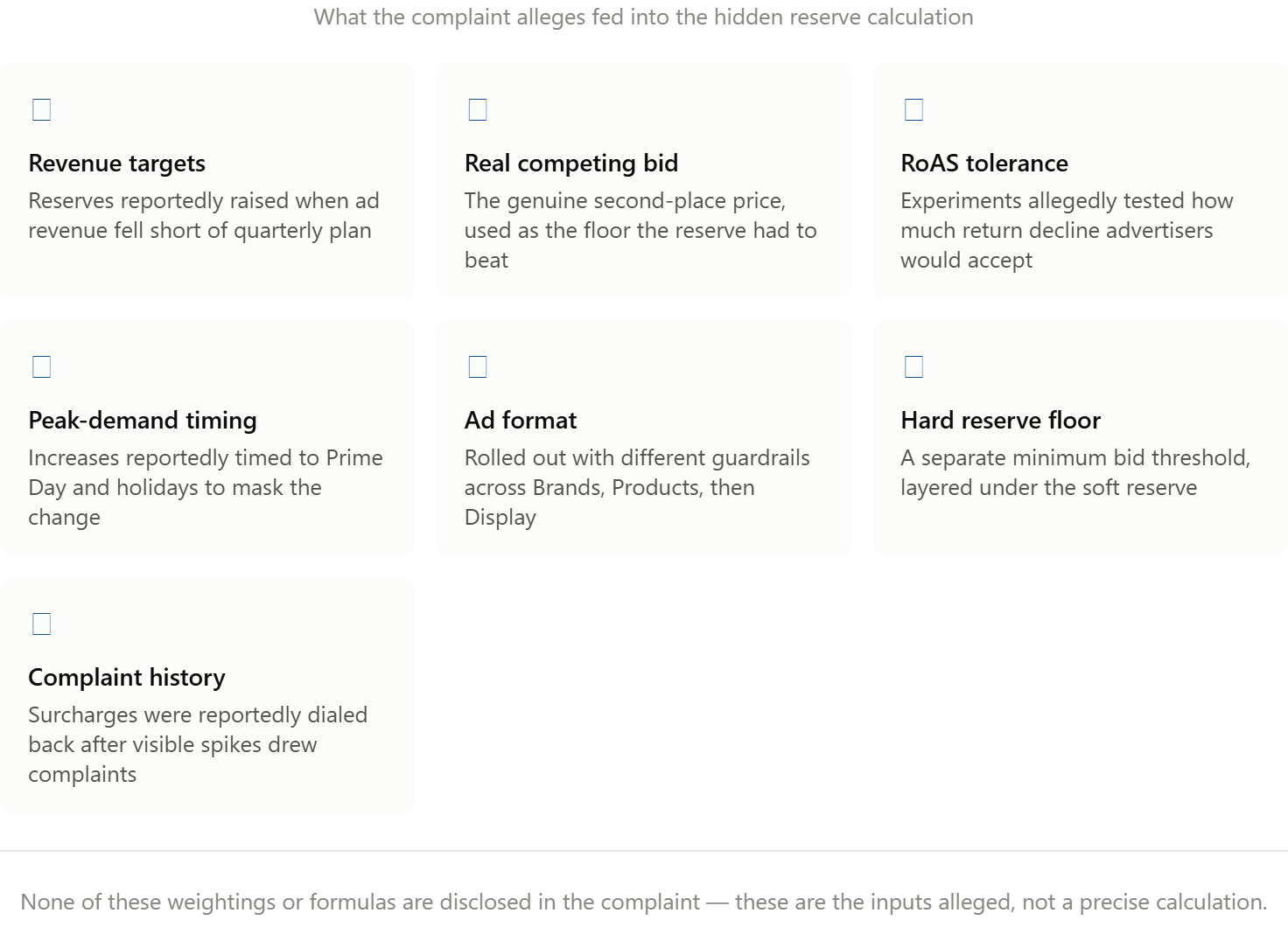
One internal Sponsored Products memo cited in the complaint summarized the logic bluntly: reserve prices don’t change which ad wins — they just make advertisers pay more for the same result, a benefit to Amazon that comes at advertisers’ expense.
3. Why This Changes How You Should Think About Bids
If GSP pricing worked as advertised, your bid was a ceiling, not a target — you could bid your true maximum value with little risk of actually paying it. That assumption shapes real decisions: how aggressively to bid, how much headroom automated bidding is given, how you forecast spend.
The complaint includes a direct example of an advertiser making exactly this kind of decision. In a February 2024 email, an advertiser asked Amazon’s own SVP of Amazon Ads whether a high bid would actually be charged in full, or only “the going rate for that keyword.” The SVP replied using the same second-price framing Amazon used publicly — that the charge depends on the next-lowest bid, not the advertiser’s own.
The complaint’s ~80% figure (advertisers paying their full bid by 2024) suggests that ceiling may not have held reliably. If a bid increasingly functions as the actual charge rather than a safe upper limit, the bidding logic built on the old assumption — bid your true value, let the auction protect you — no longer holds the same way.
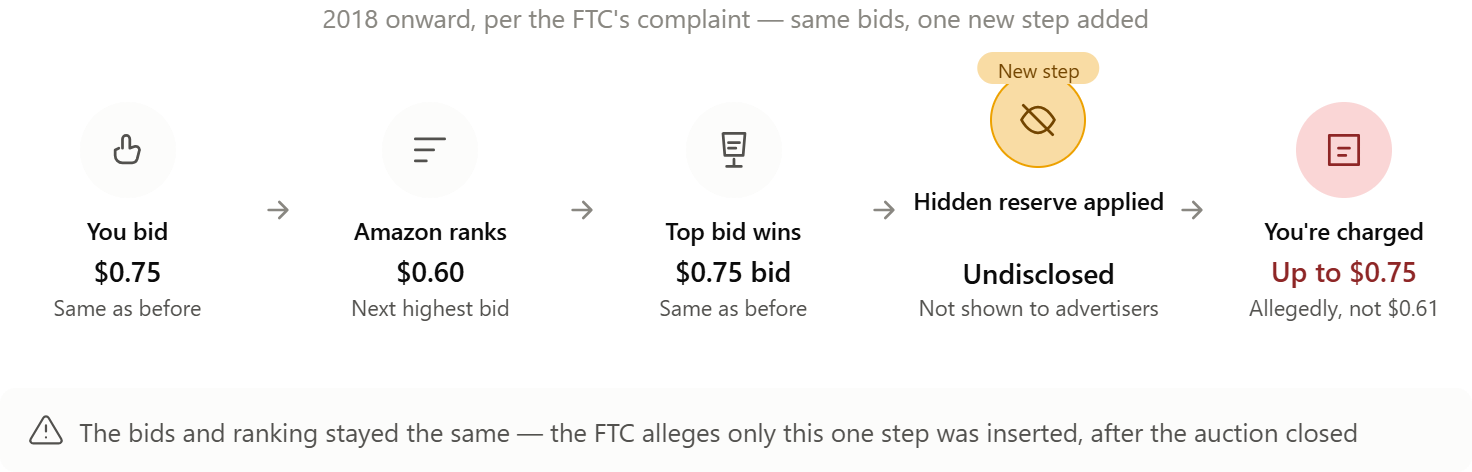
The FTC’s argument centers on exactly this: advertisers were making real bidding decisions based on an understanding of the auction that, per the complaint, no longer matched how Amazon was actually charging them
4. Timeline of Key Events Alleged in the Complaint
| Period | What allegedly happened |
|---|---|
| 2012–2018 | Amazon runs genuine GSP auctions with no reserve pricing — consistent with what it told advertisers. |
| 2018 | Amazon launches undisclosed soft-reserve pricing on Sponsored Brands first, after deciding GSP prices were leaving revenue “on the table.” |
| 2019 | Soft reserve pricing expands to Sponsored Products, introduced with “conservative guardrails” specifically to avoid tipping off advertisers and damaging trust. |
| 2020 | Amazon reportedly tests loosening pricing constraints during peak shopping days, theorizing that normal seasonal price/competition swings would mask (the complaint says “obfuscate”) the extra markup. |
| Dec 2021 | A rapid surcharge increase causes a sharp, visible CPC spike. More than 20 agencies/advertisers raise concerns. Amazon allegedly convenes an internal “war room,” dials back the surcharge, and tells advertisers the spike was due to normal holiday shopping demand — not a pricing change. |
| 2023 | Amazon adds reserve pricing to Display Ads. Large-scale internal pricing experiments test how much RoAS advertisers will tolerate before reacting. |
| Jul 2023 (Prime Day) | Another surcharge increase produces at least seven advertiser escalations; one large food/beverage advertiser reportedly sees CPCs jump 90%+. Amazon’s PR/legal-approved response again attributes it to shopper/advertiser “engagement,” not a pricing change. |
| Aug–Sep 2024 | Amazon researchers publish a KDD (data-mining conference) paper referencing “soft pricing” and reserve prices. Once a Sponsored Products manager notices it’s publicly accessible, it’s pulled from Amazon’s site and the conference site within days. |
5. Advertisers may have been paying their own bids more often
One of the FTC’s most significant allegations concerns how frequently advertisers allegedly ended up paying their full bids.
According to the complaint, for Sponsored Products:
- In 2021, advertisers paid their bid approximately 30%–40% of the time.
- In 2022, that figure rose to around 70%.
- By 2024, the FTC alleges advertisers were paying their bid approximately 80% of the time.
The FTC attributes this increase to the alleged surcharge mechanism.
If accurate, this would be particularly significant for advertisers because a bid that was historically interpreted as a maximum CPC could increasingly function as the actual CPC paid.
Important: these are allegations in the FTC’s complaint, not findings that have been established by a court.
6. Scale of the Alleged Harm
- ~1.2 million U.S. advertising customers affected, including 500,000+ small and medium-size businesses.
- $20 billion+ allegedly extracted since the scheme began (the FTC’s own figure; some outlets report Amazon disputes this framing entirely).
- Amazon’s advertising business generates $68 billion+ in annual revenue, with Sponsored Products as by far the largest contributor.
- The complaint alleges advertiser RoAS hit an “all-time low” in the U.S. marketplace in 2024, declining roughly 10% in Q1 2024 alone, with a “large share” of sellers in several top categories reportedly operating at negative margins.
- Documented individual incidents include CPC spikes exceeding 90% for at least one large advertiser during Prime Day 2023.
7. Amazon’s response
Amazon strongly disputes the FTC’s allegations.
In its response, Amazon argues that the FTC fundamentally misunderstands how Amazon’s advertising auctions work and how advertisers make bidding decisions. Amazon says advertisers do not simply rely on descriptions of auction mechanics; sophisticated advertisers use performance data, automated bidding systems and real-time reporting to determine bids.
Key points from Amazon’s response:
- Amazon says the complaint offers no evidence that consumers paid more, and that consumers are barely mentioned in the 181-page filing.
- Amazon estimates its relevance-based auction model delivered advertisers $8 billion+ in savings from 2021–2025, compared to a pure highest-bid-wins system.
- Average winning bids for Sponsored Products fell roughly 50% from 2019 to 2025, and about 92% of placements don’t go to the single highest bidder — evidence, in Amazon’s view, that the system isn’t designed purely to maximize extraction.
- Inflation-adjusted average CPC for Sponsored Products stayed flat from 2019–2024, and individual advertiser conversion rates (CVR) rose 24% from 2021–2025, per Amazon’s figures.
- Amazon says advertisers respond to real campaign performance and automated bidding data, not to descriptions of auction mechanics.
- Amazon says its Ad Console Campaign Builder has clearly communicated since 2018 that a bid represents the maximum an advertiser could be charged — and that older, simplified training materials describing a strict “penny more than second place” model were low-reach resources that have since been removed or updated.
- Amazon says it has since added explicit reserve-pricing language to its Help content and introduced regular audits and updated sales training.
- Amazon says it looks forward to “making our case in court.”
For context: this follows Amazon’s separate $2.5 billion FTC settlement in September 2025 over alleged deceptive Prime subscription practices, and sits alongside a broader antitrust case against Amazon (covering pricing algorithms and ad operations generally) scheduled for trial in early 2027.
The Core Disagreement
Distilled to one question: what does an advertiser’s bid actually represent?
- The FTC’s position: advertisers were led to believe they were in a competitive second-price auction, while Amazon used an undisclosed mechanism that could push the price well above the competitive result.
- Amazon’s position: a bid was always communicated as a maximum charge, not a guaranteed second-price outcome — and “maximum CPC” was never meant to be interpreted as “expected CPC under GSP.”
Both sides’ headline numbers — the FTC’s $20B+ overcharge estimate and Amazon’s $8B+ savings estimate — are calculated on different bases and neither has been tested in court.
8. What This Means for You as an Advertiser, Right Now
Treat both sides’ numbers as claims, not settled fact.
Nothing is proven yet. This is a complaint. Amazon will file a response, and the case proceeds through discovery, motions, and likely years of litigation — or a settlement — before anything is resolved.
No action is required today. There’s no claims process yet. One would only emerge if the case settles or the FTC/states prevail and a remediation fund is established — common in FTC enforcement actions, but not guaranteed.
Keeping your own historical records may help later. If you have historical CPC, bid, and RoAS data — especially around the flagged periods (Dec 2021, Prime Day/HVE spikes in later years) — holding onto it could matter if a restitution process is eventually created.
Watch the docket, not just headlines — filed as 2:26-cv-03097, U.S. District Court for the Western District of Washington.
9. Practical Takeaways for PPC Managers
Regardless of how the case plays out, a few habits are worth reinforcing:
- Don’t look at bids in isolation. Your bid is one input among many — monitor actual CPC alongside conversion rate, sales, and profitability.
- Track auction behavior over time, not just campaign-by-campaign. Historical patterns between bids, CPCs, and performance often aren’t visible in a single snapshot.
- Understand the logic behind automated bidding, even when you’re not setting each bid manually — automation can make thousands of pricing decisions on assumptions you should still be able to explain.
- Don’t assume every CPC increase signals a problem. Competition, seasonality, relevance, and conversion probability all move CPCs independently of any pricing-mechanism dispute.
- Preserve historical CPC, bid, spend, and performance data. If auction rules or disclosures change going forward, a clean historical baseline is the only reliable way to spot what actually shifted.



Stop the wasted ad spend. Get more conversions from the same ad budget.
Our customers save over $16 Million per year on Google and Amazon Ads.