

This week’s PPCChat, hosted by Julie F. Bacchini, was inspired by Google Ads’ latest update to how limited budgets are communicated. The discussion explored how PPC experts explain these changes to their clients and which advertising platforms do the best job of communicating product updates and feature changes.
Q1: How will you explain the Google Ads limited budget changes to your clients/stakeholders? Do you expect it to be challenging explaining this change – why or why not?
Quick summary of the changes – basically, if you have campaigns that are limited budget status AND using a TROAS or TCPA bidding strategy, this change applies. Let’s say you had a target of a 5 ROAS. And your campaign is regularly getting you a 9 ROAS. Now, the campaign will essentially stop giving you the higher ROAS traffic so you are hitting your target. Google says it is for stability for advertisers…@NeptuneMoon
There are so many over-the-top warnings in Google Ads now that my clients have started to become notification-blind to them, so I don’t expect that this will raise any new questions. But, I have clients who are for the most part, stay out of the account. @Pete_Bowen
You can see the links I posted for a lot more details. This one is REALLY hard to sell/explain to clients. There is no good answer to “why can’t we still have the performance we have been getting?” Other than, cause Google says so @NeptuneMoon
I feel like the change takes away a lever that was quite useful when a campaign wouldn’t get going. Raise the Target CPA, accept the warning and usually the thing would start spending at the expected CPA @Pete_Bowen
Now established campaigns have to start the lovely process of adjusting targets and hoping that performance can remain. But we all know if you take your TROAS up or down it impacts the performance because you are changing the parameters you want Google to work within. This change just feels so much like we just realized we were giving you better than what you asked for and we can’t do that. Most advertisers would take greater efficiency/performance any day over “stability” @NeptuneMoon
I feel like this is leverage to try to keep people from “limited by budget”. Frankly, most of our clients are limited by budget, so a lot of their campaigns are affected. We’ll probably pivot to more conservative strategies, because they just do not have the budget to let things run up large bills to determine if the campaign gets the return needed to be worth it. @ynotweb
What is the definition of stability in this context? @Pete_Bowen
I will share this here too if you didn’t look at the LI post from Kirk I shared… here are my questions and Ginny’s response. @Pete_Bowen Google uses stability as the reason for this change. Let me find the quote. Sorry, it is “consistency” @NeptuneMoon
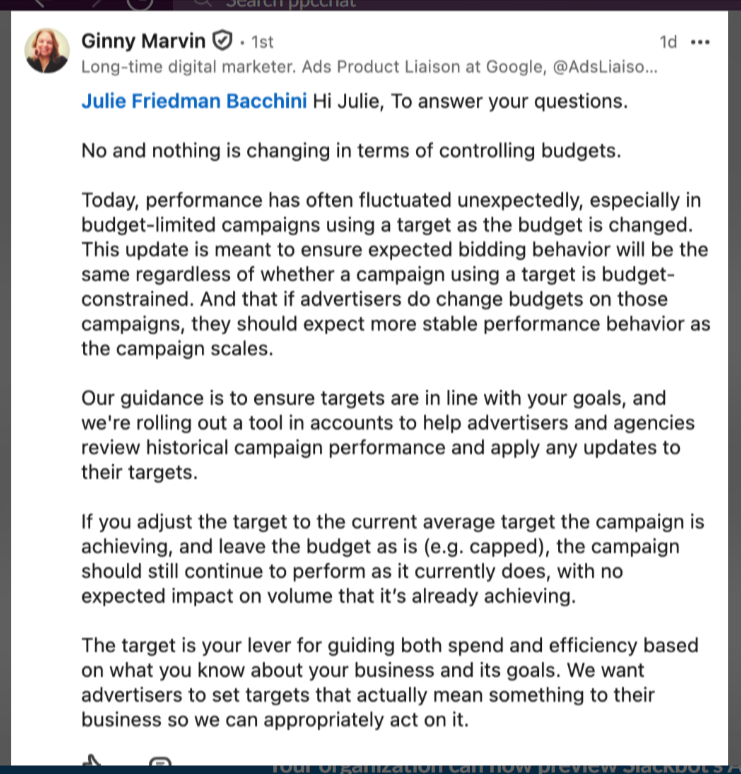
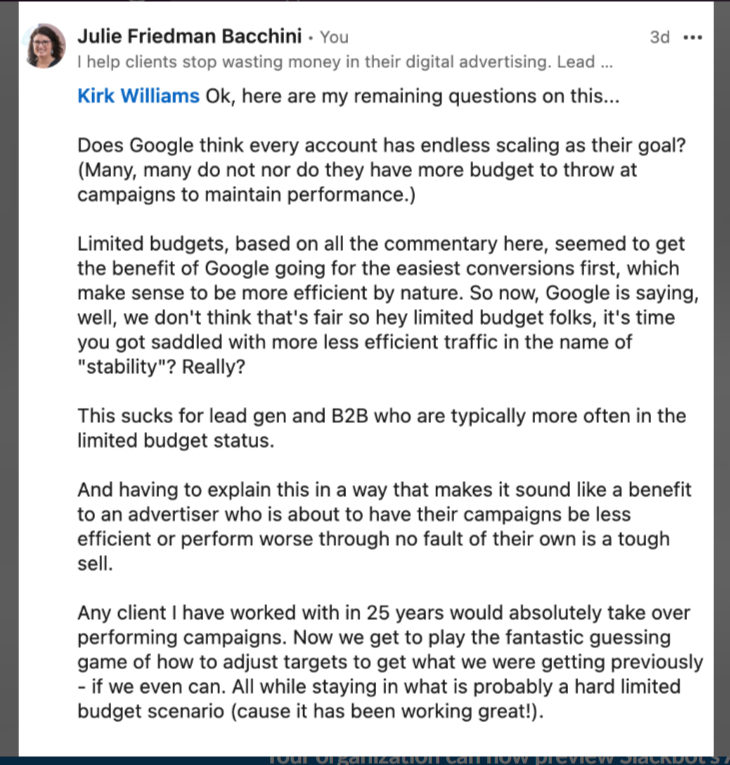
I saw that, do you know if they ever defined what they mean by consistency. It seems like a very useful word like “privacy” or “protect the children” @Pete_Bowen
From Google post about it: “Today, when your campaign has a “Limited by budget” status, if you use a Target-based bid strategy (for example, Target CPA or Target ROAS), some campaigns may be overperforming on bidding targets and see performance fluctuations when budgets are adjusted. After August 17, 2026, campaigns that are limited by budget that use a target-based bid strategy will more consistently perform toward your bid target, including when you make budget adjustments so you can grow your campaigns with more predictable performance.” @NeptuneMoon
And to answer the second part of this question, YES, it will be difficult to explain this to clients. @NeptuneMoon
If I’ve understood it right, this means that raising budget should keep the actual CPA close to the Target CPA (I’m using this example as I do lead gen and don’t usually use other targets). But that seems like an optimistic thing because of the law of diminishing returns. @Pete_Bowen
I won’t even ATTEMPT to explain to clients until I see how it actually affects them. Yes, I expect effects, no, I do not trust what they say will happen. @ynotweb
I don’t think it will be hard to explain. Just harder to know what will happen to campaigns if we adjust our tROAS/CPA before the deadline next month. Google in the end is changing how the OS works for Google Ads and we don’t get a say in how that impacts campaigns. @duanebrown
Yeah, Duane, for that reason, I am adjusting SOME of them now and waiting on others. @ynotweb
Using economic language, Google is hell-bent on taking every single bit of advertiser surplus in the market. @robert_brady
We are doing some now but a few clients operated in multiple regions… so those clients we need to do in phases to manage how things go. @duanebrown
I’ll explain it by letting them know this change joins the long list of changes to be filed under the ‘shake the cushions’ list. @alimehdimukadam
I have a few seasonal clients using tROAS and this is going to eff up a lot of work we’ve done building tROAS ranges for different locals at different times of year. 28-day average is worthless to me, because it’s so customized based on ad group + campaign + time of year + location @timmhalloran
Hi All, Chiming in here. I’ve answered a ton of questions on this on X and LinkedIn and happy to answer any more you have. Please note we’re rolling out notifications and a tool in affected accounts where you can review those campaigns and make any adjustments (starting last week). With this update, campaigns using a target will try to achieve the target you set regardless of whether the budget is limited or not. And if you change the budget on a budget-constrained campaign, you should expect more stable performance as it scales. Today, those campaigns often experience unexpected volatility as the system adjusts, which has not been a great experience and made it challenging for advertisers to scale confidently. This update aims to address that. @adsliaison
Thanks Ginny! The tool is definitely helpful @beyondthepaid
Glad to hear that, Melissa. We’re trying to give people lots of notice and tools to navigate this ahead of the update. @adsliaison
I still have concerns about this change but the tool helps us identify where we need to take action. We are going to need to be much more vigilant with target bid strategies now. @beyondthepaid
Yes, we want advertisers to set targets that actually mean something to their business so we can appropriately act on it. And the target is your lever for guiding spend and efficiency based on what you know about your business and its goals. @adsliaison
Ginny, as an example of why this is frustrating for me, I have a client that knows the booking that happen on their website (guaranteed refund), they’ll have about 65% who actually commit and purchase the package. But that percentage increases/decreases at certain times of year or certain locations. So for example, Miami will average 80% normally but in the summer, specifically the month before July 4th, and the month before Labour Day, they know that % goes down to 55% because people are booking multiples to secure a spot before they commit. We have a Google sheet that has ratios for locations at different times of year, that tell us if we get $100 conv. value in Google (via ‘bookings’ conversion), that translates to $65 of actual GMV. Multiply this by location/month and it’s relatively complex (but it works wonders too). The retort to this would likely be, “Beef up your enhanced conversion data so that actual GMV is sent back to campaigns to learn off of” which I’d agree with except it’s a relatively convoluted mix of a custom database that is integrated into other proprietary or affiliate inventory systems, so final GMV is difficult to translate back to the data inputs needed to connect the actual GMV to Google-reported conversions. I’m sure it’s possible with some engineering finesse but very difficult nonetheless. I know this is long-winded, but if I choose a tROAS of 11 in Miami, I choose that based on the target GMV I’m responsible for at the end of the month given the media spend I’m in charge of. I also have chosen 11 strategically because it drops down below 11 during weekdays and then pops up to 17 around Thurs or Fri. If Google maximizes the media budget on the weekend when I’ve already surpassed my tROAS, then what is going to happen during weekdays when demand dries up and it’s only able to give me a 7 ROAS? Will it refund me, stop spending, make the campaign go into a learning tailspin? That’s the part that makes me nervous. I’d love to believe the stability argument, so I suppose I’ll just wait and see. But many times these scrappy DIY ratios we build are out of necessity. So when bidding changes, that’s a lot of “going back to the drawing board” that’s bigger than the number Google sees. @timmhalloran
Q2: What is a recent platform change that was difficult for you to explain or “sell” to clients/stakeholders? What made it difficult?
I’m honestly still dealing with the ‘we will overspend your budget’ news from a few years ago. @JuliaVyse
Not a recent change, but keyword matching to search terms. “Why did my ad show for this?” @Pete_Bowen
The change to how daily spend works with dayparting did not go over well. Clients are still complaining about that @beyondthepaid
Any thoughts or feelings about editorial policies or have those been straight forward? Asking in general @navahhopkins
Hiding of search queries is up there too along with those already mentioned. @NeptuneMoon
Hey – Microsoft shows all search terms that result in clicks AND shows grounding queries in Clarity. Not all platforms hide the search terms @navahhopkins
And I think the common theme among these changes is that they are rolled out as somehow good for advertisers when they are not. That is the part that makes our job as being in between advertisers and a platform (in this case Google) harder. @NeptuneMoon
Old client put a new person in charge of paid ads but they had never done paid ads before. It was 3 months of explaining basic stuff and them never being happy with how the systems work e.g. Meta Andromeda @duanebrown
Do we figure out how to work in the new systems? Of course we do. But that doesn’t mean that clients are not asking things like “how come we can’t do x anymore?” or “why can’t we get performance like we used to (when something fundamentally changes that impacts them)?” @NeptuneMoon
@navahhopkins editorial policies are generally easy to understand and explain, as long as disapprovals make sense. Seen some whacky ones recently from Google @beyondthepaid
@navahhopkins Editorial policies only get weird when they are applied strangely – like the disapproval does not make sense for the product or service and the policy in question. Which has been on the rise with AI in that mix…@NeptuneMoon
Recently had to explain AGAIN why client was having SO many people call for furniture (because they used the category “Furniture Store” in the GBP, go figure!). When Google made the changes in May, it became WAY more weighted than anything I was doing. So finally they listened to me and changed it.@ynotweb
Another key for editorial policies is having a fast and easy appeal/review process to get mistakes fixed fast @NeptuneMoon
Do you have examples of that (AI causing editorial policy issues)? @NeptuneMoon Microsoft launched asset specific review to help with that! This means that unless the final url is the problem, it’s possible for compliant assets to continue to serve unless there are no compliant assets in the ad @navahhopkins
Took my a while to figure and explain why phrase match was matching related entity terms when target keyword was ‘dentist near me’, xyz in city, etc. So if someone was searching for their own brand – this would come up – circa 2023 @alimehdimukadam
Q3: Which platform(s) do you think do the best job in communicating about changes to their platform? What makes their communication good and/or helpful?
Not Microsoft. we’re trying to be better! @navahhopkins
I want to give props to @navahhopkins and @adsliaison for always doing their very best to clarify any communications @NeptuneMoon
I mean, Google does a decent job communicating, even if the news is bad. I would say the same for Microsoft and specifically @navahhopkins who is great about sharing news @beyondthepaid
I agree that Google and Microsoft put out detailed posts and update documentation in detail @NeptuneMoon
I can’t say any of them do a “good” job communicating – Google makes it look like they check the legal requirements (with GAds-only – NOT at all with other tools), MS at least doesn’t barrage us with garbage, and Meta is just the worst ever. @ynotweb
Next question is on which one(s) are the worst! @NeptuneMoon
Apart from Ginny & Navah, the best because of their closed loop is Amazon in my opinion @alimehdimukadam
If Amazon had a Ginny or Navah, they’d be unstoppable. as it stands they’re the meta of retail. I said what I said. @JuliaVyse
Sometimes there is too much news from platforms with too much change at once. @duanebrown
or just non-stop changes, even if its not all at once there’s no time to just see how that ONE change made impact- its exhausting. @ynotweb
Sometimes I think the only way to find out about the changes is to stalk LinkedIn and see what other people are seeing and posting… (other than the amazingness from Navah and Ginny!) @revaminkoff
There are some great LinkedIn newsletters to subscribe to – Thomas Eccel and Hana Kobzova come to mind @beyondthepaid
Q4: Which platform(s) do you think do the worst job in communicating about changes to their platform? What makes their communication bad and/or unhelpful?
I don’t really work in Meta these days but I see a lot of posts with people who do guessing as to backend changes that were not announced @NeptuneMoon
Meta x3000 @ynotweb
Meta just rolls stuff out without explanation. Still trying to understand the logic behind “Now you don’t get to choose your crop, just upload one aspect ratio and hope for the best across every placement” @williamhboggs
They announce NOTHING. @ynotweb
Meta. you find out about these things just being on IG and seeing weird stuff happen @JuliaVyse
Even other professionals don’t know that they didn’t notice something. and sometimes, when you notice it, a week later you can’t find it again. @ynotweb
Oh and my other favorite recent addition in meta: Website Highlights and Related Creative: “We don’t care what you make as an ad, we’re going to pull random content from your page and random screenshots of your website instead. btw this is opt-out not opt-in and may or may not be available on your account – we’ll keep you on your toes!” @williamhboggs
Here to second Meta not announcing anything. I feel so out of the loop sometimes… @revaminkoff
The rule is, if Meta announces it (Libra, Metaverse) it will crash and burn shortly. if they don’t mention it, it’s on all your accounts! @JuliaVyse
They used to have events and webinars and be proactive, but I think since the layoffs, that’s stopped. @revaminkoff
Those events were such nonsense. @JuliaVyse
Meta for sure @duanebrown
“What makes their communication bad” #1 because you’re not able to get ahold of a representative, or support is hidden using dark UI practices that make you give up. Be it a $1,500/mo. ad spend account, or a $280K/mo. it makes no difference, support is nearly the same. Nonexistent, and when you did get a human, they give you corporate copy-pasta that you need to respond to within 8 hours, otherwise they close your ticket. “and/or unhelpful?” Their teams pass you off like a phone tree. It’s like the good ol’ days of Comcast. If you mention a keyword that applies to another team, they’ll send you around so they can get you off their plate. And they’re happy to roll up the ticket if you don’t respond within a workday. And honestly, it’s sad because one of the best reps I had was a Meta rep back in 2019-2020 out of Chicago who went out of her way to advocate for my brands internally at Meta. One of the best. I think she got promoted, and since then I’ve never had an agency rep and/or a good rep since. @timmhalloran
Q5: What type of changes do you dread the most having to explain?
When platforms remove metrics/reporting clients were relying on, that is the worst and hardest to explain. Example: RIP Impression Share. @revaminkoff
Anything that’s going to have a negative impact, ie the dayparting change and now this target thing. Taking away levers @beyondthepaid
When something that a client has been using or doing for years is no longer available or changes drastically. Those are hard to explain without just reverting to “random acts of Google” or something like that. Side note – I have language in my contracts about random acts of Google (or whatever platform I am working with that client on) and how it may result in additional charges if big changes in accounts are needed or big change in regular monitoring cadence…@NeptuneMoon
Years ago I helped a laptop repair company grow from 1 person to a serious operation. Then, one day Google decided that they couldn’t advertise anymore. 3rd party repair policy. That was it. Killed the business. I dread something like this happening again. @Pete_Bowen
The changes that remove control and the ones that impact effectiveness of budget. “Why is it suddenly saying we need 10 times the budget?” @ynotweb
@ynotweb you said it better than I did @beyondthepaid
“I have language in my contracts about random acts of Google” @NeptuneMoon same! Just recently put in in the past year, because at certain times of year, I’ll have to pour 40-50% of my billables for an SOW into fixing something Meta/Google broke @timmhalloran
When platforms change the rules that guided how the platform operated, that can be really hard to explain because you basically have to reeducate the client on the entire platform – ex: the way the use of match types on Google has completely changed or the shifting role of AI @revaminkoff
@revaminkoff Expanding on that – so much of what we have traditionally sold as the primary benefits of doing PPC is no longer how it was. So for long time advertisers, who have built expectations that are suddenly not accurate with changes to platforms. @NeptuneMoon
Also any loss of support reps! Clients ask “why?!” and “what can we do?” and the answer is often “no reason and nothing” @revaminkoff
PPCChat Participants
- Julia Vyse @JuliaVyse
- Julie F Bacchini @NeptuneMoon
- Navah Hopkins @navahhopkins
- Ali Mehdi Mukadam @alimehdimukadam
- Tim Halloran @timmhalloran
- Duane Brown @duanebrown
- Reva Minkoff @revaminkoff
- Kammy Caruss @ynotweb
- Peter Bowen @Pete_Bowen
- Melissa L Mackey @beyondthepaid
- Ginny Marvin @adsliaison
- Robert Brady @robert_brady
- Boggs @williamhboggs
Related Links


Stop the wasted ad spend. Get more conversions from the same ad budget.
Our customers save over $16 Million per year on Google and Amazon Ads.