

Amazon ads can definitely help bring shoppers to your product listings and drive sales. But the real question is whether your ad spend is actually working for you. That’s where ACoS comes in — it helps you understand if your PPC budget is being spent wisely or just getting burned.
TL;DR
- ACoS shows how efficiently your ads generate sales and remains a key metric in 2026.
- A “good” ACoS depends on your profit margin, not a fixed benchmark.
- Rising CPCs and competition are making ACoS harder to maintain
- Focus on conversion, keyword targeting, and campaign structure to improve ACoS
- Adjust ACoS based on product lifecycle (higher for new products, lower for mature ones)
- Use tools like attribution and negative keywords to reduce wasted spend
- Combine automation with control to keep ACoS profitable
In e-commerce, Amazon advertising remains one of the most powerful performance-driven channels. Even with AI tools and automation doing much of the heavy lifting, ACoS still plays a role in almost every advertising decision.
But what actually counts as a “good” ACoS in 2026? Have the benchmarks shifted? And how do you stay profitable when Amazon’s algorithms are making more of the optimisation decisions for you?
Let’s take a closer look at ACoS and what it means in today’s market.
What is ACoS, and Why Does It Still Matter for Advertisers in 2026?
ACoS (Advertising Cost of Sales) shows how much you spend on ads to generate every dollar of sales on Amazon.
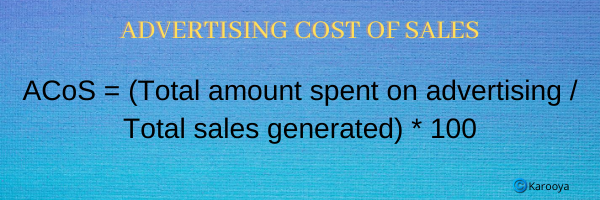
So, if your Amazon Ads campaign brings in $300 in sales while you spend $75 on ads, your ACoS would be (75/300) × 100 = 25%. In simple terms, you’re spending 25% of your revenue on advertising to generate those sales.
ACoS in Amazon PPC is an important metric that measures your advertising performance. A high ACoS indicates you’re spending a lot but not generating valuable sales. On the other hand, low ACoS means that your advertising spend aligns closely with your goals and generates revenue.
Despite the rise of new metrics, ACoS remains the primary optimisation metric in Amazon Ads. Here is why it matters for advertisers:
- ACoS gives advertisers quick insight into how their campaigns are performing, helping them make smarter bidding and budgeting decisions.
- Break-even ACoS helps indicate whether your advertising is financially sustainable.
- Though AI is influencing many PPC metrics, performance optimisations still depend on ACoS and conversion rate.
Defining Your ACoS Targets: Know Your Margins
Defining the ACoS targets helps advertisers understand the product margins. Your product margins determine how much you can spend on advertising and still turn a profit.
1. Calculate your profit margins
When selling your products on Amazon, you need to see the cost involved. Subtract the cost of manufacturing, shipping, Amazon fees, discounts, coupons, etc. This will help you to know the accurate ACoS target. Basic formula of profit margin:
Profit Margin (%) = (Profit ÷ Revenue) × 100
So, if the selling price is ₹3000 and orignal cost is ₹2000, profit would be ₹1000. To calculate the % of profit margin = ( 1000 ÷ 3000 ) x 100 = 33%
Ignoring your profit margins can lead to unrealistic ACoS goals.
2. Know your break-even ACoS
Every advertiser aims to make a profit, but break-even ACoS is an important benchmark to keep in mind. It’s the point where your advertising spend equals your profit margin. At this stage, you’re not making a profit—but you’re not losing money either.
3. Adjust ACoS as per your business goals
An ACoS target shouldn’t be the same for every business goal. When launching a new product, the focus is usually not on immediate profit but on gaining reviews and improving organic rankings. During this phase, your target ACoS may go above the break-even point.
However, for products with good organic rankings and decent reviews, you want to maximise efficiency. Here, your target ACoS should be 5-15% below your break-even ACoS.
Amazon ACoS Benchmarks in 2026: The Reality Check
We need to accept the reality. Due to rising competition and higher CPC (up 15.5% Y/Y) in 2026, advertisers need aggressive bidding strategies and tighter optimisation.
The term “good ACoS” isn’t universal—what’s considered good in one category may be poor in another. Industry data provides a useful reality check. If we see ACoS data by categories:
| Categories | ACoS Range | Average CPC | Notes |
|---|---|---|---|
| Beauty & Personal Care | 18-28% | $1.45-$1.55 | Repeat purchases drive higher spending |
| Home & Kitchen | 15-27% | $1.00-$1.18 | Can reach 30% during the Q4 gifting season |
| Clothing & Jewelry | 22-38% | ~$0.89 | Most variation — driven by visuals and trends |
| Electronics | 13-21% | $1.35-$1.60 | Tight margins, strong competition |
| Pet Supplies | 20-32% | $1.20-$2.50 | Repeat or subscription customers can justify a higher ACoS |
Here are the CPC and ACoS benchmarks concerning the ad formats in 2026
| Ad Format | Average CPC | Average ACoS |
|---|---|---|
| Sponsored Products | $1.20 to $1.80 | 20% to 35% |
| Sponsored Brands | $1.50 to $2.50 | 25% to 40% |
| Sponsored Display | $0.50 to $1.20 | 30% to 50% |
These numbers suggest that the steady rise in ACoS is largely driven by increasing CPCs. This means that maintaining the same ACoS is becoming harder. At Karooya, we believe that the real benchmark is not an industry number—it’s your margin-driven break-even ACoS. The most successful advertisers treat ACoS as a strategic metric, adjusting targets based on product lifecycle, competition, and growth goals.
Optimisation Strategies for ACoS in 2026
In 2026, ACoS optimisation is not about quick tweaks, it’s about building up the structure, strategy and gaining profit. Here are some ways you can approach ACoS in 2026.
1. Start calculating the profit, not ACoS
Instead of focusing only on ACoS, start focusing on margins. This will help you to decide what ACoS you can afford. ACoS is derived from profits, so it is good to keep in mind the following:
- true break-even ACoS
- acceptable ACoS range
- setting different targets per product
2. Focus on conversions
Your product listing plays a major role in drawing conversions. If your listing does not convert, any optimisation will not fix the ACoS. It’s advisable to focus on:
- the visuals that provide the unique look of the products
- competitive pricing
- good reviews and ratings
3. Search term mining
Making search term analysis a core routine helps in knowing your keywords better. The Search Terms Report is a valuable way to see exactly what shoppers are searching for. It helps you to decide which terms to target and which to avoid.
Terms that are not converting can be added as negative keywords to help avoid wasted ad spend.
Karooya’s Negative Keywords Tool for Amazon Ads analyzes your search query data in depth, helping you quickly spot irrelevant or low-quality traffic—something that would otherwise take a lot of time to do manually.
4. Align ACoS with product life cycle
It is not advisable to keep a single ACoS target for all your products. ACoS should depend on which stage your product is in.
- new in the market- higher ACoS
- gradual growth- balanced ACoS
- gaining profit – lower ACoS
- declining profit- controlled ACoS
5. Using the Amazon attribution tool
Karooya’s Amazon attribution tool helps optimise ACoS by solving data blindness that occurs while driving traffic from external sources to Amazon. Here is how it helps:
- It uses keyword-level tracking to connect Google Ads spend with Amazon Attribution sales. This helps you increase bids on profitable keywords and cut back on those driving high ACoS.
- Sometimes, individual keywords don’t get enough clicks to show a reliable ACoS. That’s why Karooya looks at portfolio-level data to make smarter bidding decisions.
6. Use automation with boundaries
Nowadays, automation has become a major part of PPC, but it is wise to use it with some boundaries.
- monitor performance regularly
- set strict ACoS thresholds
Conclusion: The ACoS Reality in 2026
Keeping ACoS healthy in 2026 is getting tougher as automation takes a bigger role. To stay on track, know your true ACoS margins, let automation handle routine bidding, and focus on ad quality and precise targeting.
FAQ’s, But Make It Simple
What is a good ACoS on Amazon in 2026?
In 2026, a “good” Amazon ACoS generally ranges between 15% and 35%, but the right number depends on your profit margins and goals.
Should new products have higher ACoS?
Yes, new products typically have a higher ACoS, and that’s normal.
Is lower ACoS always better?
No, a lower ACoS isn’t always better. Usually, it shows higher profitability, but it can also mean that you are missing out on visibility and potential sales growth.
How often should you adjust ACoS targets?
ACoS targets should be reviewed regularly, rather than on a fixed time. One should review and update the ACoS targets when:
- Margins change
- Product lifecycle evolves
- CPCs increase
- Change in seasonal demand
What matters more: ACoS or ROAS?
Neither. ACoS focuses on cost efficiency, and ROAS focuses on return. Use of these metrics depends on how you measure performance. One should not rely on either of these alone.
Why is my Amazon ACoS increasing?
Usually, increasing ACoS shows that you are spending more to get the same or fewer sales. But there are other reasons too:
- rising CPCs
- low conversion rate
- increased competition
- seasonal changes
- aggressive bidding strategy
What impacts ACoS the most?
Three drivers: CPC, conversion rate and keyword relevance
Can AI tools reduce ACoS automatically?
AI can definitely boost efficiency and help optimise ACoS, but the best results come from combining automation with human strategy. However, AI tools can help reduce ACoS by:
| Adjusting bids in real time | budget allocation with efficiency | Identifying good and poor-performing keywords | Budget allocation with efficiency |
What is the biggest ACoS mistake brands make?
The biggest ACoS mistake brands make is treating it as the end goal instead of a strategic metric. The aim isn’t the lowest ACoS, but the right ACoS that supports profitable growth.
Related Links


Stop the wasted ad spend. Get more conversions from the same ad budget.
Our customers save over $16 Million per year on Google and Amazon Ads.