

Every advertiser wants quality leads, but even with optimised bids and precise targeting, spam and low-intent leads can fill the pipeline without driving business growth. Recognising that lead generation is a quality and measurement challenge, not just a volume game, Google is building solutions focused on capturing genuine intent.
At Google Marketing Live 2026, Google unveiled 42 new product launches and enhancements specifically for lead-generation advertisers. Powered by AI, these updates include smarter ad experiences and improved lead qualification. These new automation tools are designed to connect marketing efforts more closely to business results.
Here’s a roundup of the most significant innovations that can help you stay ahead and strengthen your lead generation strategy.
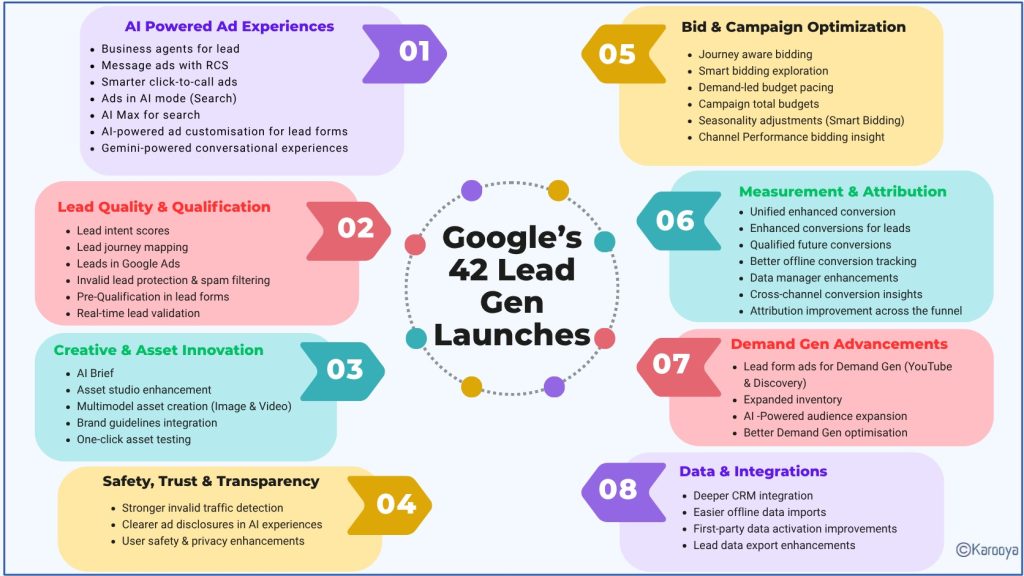
AI Is Taking Lead Generation Beyond Forms
Lead generation has long been centred around landing pages and forms, but Google’s new features point to a more conversational future—one that can create more meaningful interactions and higher-quality conversions.
| Features | Explnation |
|---|---|
| Business Agent for Leads | Powered by Gemini, this feature lets potential customers interact with businesses directly through Search ads. Instead of submitting a form and waiting to hear back, users can ask questions, get instant answers, and determine whether the business is a good fit before becoming a lead |
| Message Ads with RCS | Google is upgrading click-to-message ads with Rich Communication Services (RCS), enabling businesses to connect with prospects through AI-powered, personalized conversations on Android and iOS |
| Improved click-to-call ads | If calls are your preferred way to connect with customers, Gemini can help. It identifies which calls lead to conversions. It filters out wrong numbers and low-intent calls. It also shows which campaign drove each qualified call |
| Ads in AI Mode | Google is testing ads in AI Mode, helping businesses reach users as they research solutions. The ads display relevant offers and business details with clear sponsorship labels |
Google Prioritises Lead Quality Over Quantity
Whether you’re a small business or a large enterprise, attracting high-quality leads is always a top priority. At this year’s Google Marketing Live, the emphasis was on helping advertisers generate better-quality leads, not just increasing the number of leads.
| Features | Explanation |
|---|---|
| Leads in Google Ads | Think of it as a built-in, lightweight CRM that keeps all Google Form leads in one place, making it easier for sales teams to track and follow up with prospects. |
| Lead Intent Scores | Not all leads are profitable. Lead intent scores help advertisers to understand the strongest prospects, making it easier for sales teams to focus on the leads most likely to become customers. |
| Lead Journey Mapping | Lead Journey Mapping shows how prospects move through the funnel and where they drop off, helping marketers identify and fix conversion roadblocks. |
| Invalid Lead Protection | Google has enhanced its invalid traffic detection systems to identify better and block low-quality traffic, helping advertisers reduce spam leads before they reach their sales pipeline. |
| Journey-Aware Bidding | Traditional Smart Bidding focuses on the final conversion, while Journey-Aware Bidding learns from multiple stages of the customer journey to optimise for revenue, not just leads. |
Better Measurement Is Finally Arriving
Lead generation has long suffered from attribution gaps, especially when sales cycles stretch across weeks or months. These features directly address this challenge:
| Features | Explanation |
|---|---|
| Unified Enhanced Conversions | This combines web and lead conversion data in one place, helping advertisers recover conversions that might otherwise be missed using securely matched first-party data. It’s especially useful in industries like automotive and finance, where someone might see an ad in January but only take action months later. This ensures those delayed conversions are still properly attributed. |
| Enhanced Conversions for Leads | This provides a more reliable measurement using first-party data. That’s the reason Google continues to encourage advertisers to move beyond traditional Offline Conversion Import |
| Qualified Future Conversions | Advertisers see the long-term value of their leads by estimating future outcomes that happen beyond the usual attribution period, giving a clearer picture of a campaign’s overall impact. |
| Data Manager Enhancements | New data integrations make it easier to bring CRM and offline sales data into Google Ads, helping its bidding system use better information to improve campaign performance |
Unlock New Search Opportunities with AI Max
Another key focus is helping advertisers reach new audiences they may have missed before. This can drive more conversions while maintaining similar efficiency levels.
| Features | Explanation |
|---|---|
| Smart Bidding Exploration | Smart Bidding Exploration helps advertisers discover new search categories that can drive conversions, even if they might be overlooked due to strict ROAS goals |
| Demand-Led Budget Pacing | Google’s new demand-led budget pacing automatically adjusts spend according to real-time search demand while staying within budget limits |
| Campaign Total Budgets | Advertisers can now set campaign budgets for specific time periods rather than managing only daily budgets, making seasonal and event-based promotions easier to control |
| AI Max for Search | Google says AI Max is unlocking billions of additional search opportunities by understanding intent rather than relying solely on keyword matching |
As mentioned in Google’s official blog post:
Banking institution BBVA used Smart Bidding Exploration with a 20% ROAS tolerance alongside AI Max, and were able to achieve a 155% surge in new high-quality leads, all while decreasing their cost per lead by 3%.
Creative Production Is Becoming Easier
Every marketer wants to create better ads, but doing it faster is just as important. These Google Marketing Live launches are designed to help make that possible.
| Features | Explanation |
|---|---|
| Asset Studio Enhancements | Asset Studio is becoming a one-stop hub in Google Ads for creating, managing, and testing ad creatives. Teams can generate on-brand static and video ads from a URL, marketing brief, and campaign goals, making it easier to produce more creative assets without increasing costs. |
| AI Brief | AI Brief allows marketers to provide strategic direction using natural language, helping Google’s AI generate assets that align with campaign goals and messaging requirements. |
| Brand Guideline Integration | A way to direct and control Google’s automation using natural language and set boundaries for AI behaviour. Specifically, you can tell the AI what your ads can and cannot say to stay on-brand, which searches to target or avoid, and how to customize messages for different customer groups. |
| Multimodal Asset Creation | Google is making it easier to generate image and video assets from simple inputs such as URLs, creative briefs, and existing marketing materials. |
Demand Gen Continues to Grow
During GML 2026, Demand Gen received several important updates designed to expand reach, improve measurement, and make campaign creation easier.
| Features | Explanation |
|---|---|
| Demand Gen Ads on Google Maps | Demand Gen campaigns will soon be able to reach users on Google Maps through a new Promoted Pins ad format. This creates a valuable opportunity for advertisers to connect with people as they explore and research local businesses and services nearby |
| Lead Form Ads for Demand Gen | Google has added Lead Form Ads to Demand Gen campaigns, making it easier for businesses to collect leads directly from engaging visual ads without sending users to a landing page first |
| Automotive Feeds for Demand Gen | Automotive advertisers can now use vehicle inventory feeds in Demand Gen campaigns to show personalised ads based on vehicles currently in stock |
| AI-Assisted Campaign Creation | Google introduced AI-powered tools that help advertisers create Demand Gen campaigns more quickly |
| View-Through Conversion (VTC) Optimization | With support for View-Through Conversions, Demand Gen campaigns can now measure the impact of video and visual ads beyond clicks |
| Campaign Type Attribution | Campaign Type Attribution gives advertisers a clearer picture of how Demand Gen campaigns work together with Search, Performance Max, and other campaign types |
Karooya’s Take on Google’s 42 Lead Generation Launches
Karooya’s perspective is simple: reduce wasted ad spend and focus on the metrics that drive real business results rather than focusing on AI hype alone. With its n-gram-based negative keyword analysis and attribution tools, advertisers can uncover wasted spend, refine targeting, and gain deeper visibility into keyword-level sales performance.
For Karooya, features like Business Agent for Leads and Lead Intent Scores highlight Google’s growing emphasis on smarter lead qualification and conversion optimisation. Lead Intent Scores help identify leads that are more likely to convert while filtering out spam and low-quality inquiries. Similarly, Karooya’s Negative Keywords Tool is built on the idea that not all clicks are valuable, helping advertisers block irrelevant traffic before it reaches the funnel.
However, as Google expands automation through AI Max and Smart Bidding Exploration, advertisers can create more opportunities to reach broader audiences, but it can also introduce irrelevant traffic if campaigns are not monitored closely.
Automation can help protect your budget, but it shouldn’t replace active campaign management.
Karooya would view these new features as powerful ways to stop wasting money on irrelevant clicks; however, it’s good to remember that automation still requires human observation to prevent Google from overspending.
Related Links


Stop the wasted ad spend. Get more conversions from the same ad budget.
Our customers save over $16 Million per year on Google and Amazon Ads.