

Amazon advertisers today have more optimization software options than ever before. While most platforms promise better performance and less manual work, they often approach campaign management in fundamentally different ways.
Some focus on helping advertisers understand search behavior. Others prioritize large-scale automation. Some increasingly rely on artificial intelligence to make optimization decisions on behalf of advertisers.
Three platforms that frequently appear in conversations around Amazon advertising optimization are Karooya, Pacvue, and Perpetua.
Although all three support Amazon advertisers, they are designed with different priorities in mind. This makes direct comparisons difficult unless specific capabilities are examined individually.
This article compares the three platforms across three areas that directly influence campaign efficiency and profitability:
- Negative keyword management
- Search term archival and historical analysis
- Ad scheduling and dayparting
Rather than identifying a single winner, the goal is to understand where each platform is strongest and which type of advertiser is likely to benefit most.
TL;DR
Karooya, Pacvue, and Perpetua all help Amazon advertisers improve campaign performance, but they approach optimization differently.
- Karooya focuses on search-term analysis, negative keyword discovery, search term archival, and advertiser-led optimization.
- Pacvue focuses on enterprise-scale retail media management, automation, analytics, and commerce intelligence.
- Perpetua focuses on AI-driven campaign optimization designed to reduce manual effort.
All three platforms offer support for negative keyword management and ad scheduling, but they differ significantly in how recommendations are generated, how historical search data is handled, and how much control remains with the advertiser.
Negative Keywords
Why Negative Keywords Still Matter in 2026
Even as Amazon advertising becomes increasingly automated, negative keywords remain one of the most effective optimization levers available to advertisers.
Every irrelevant search query that generates clicks without conversions consumes budget that could otherwise be directed toward profitable traffic.
Negative keywords help advertisers:
- Reduce wasted spend
- Improve targeting precision
- Improve ROAS and ACoS performance
- Eliminate irrelevant search traffic
- Improve overall campaign efficiency
The challenge isn’t adding negative keywords. The challenge is identifying which search terms should be excluded without accidentally restricting profitable traffic.
This is where Karooya, Pacvue, and Perpetua take different approaches.
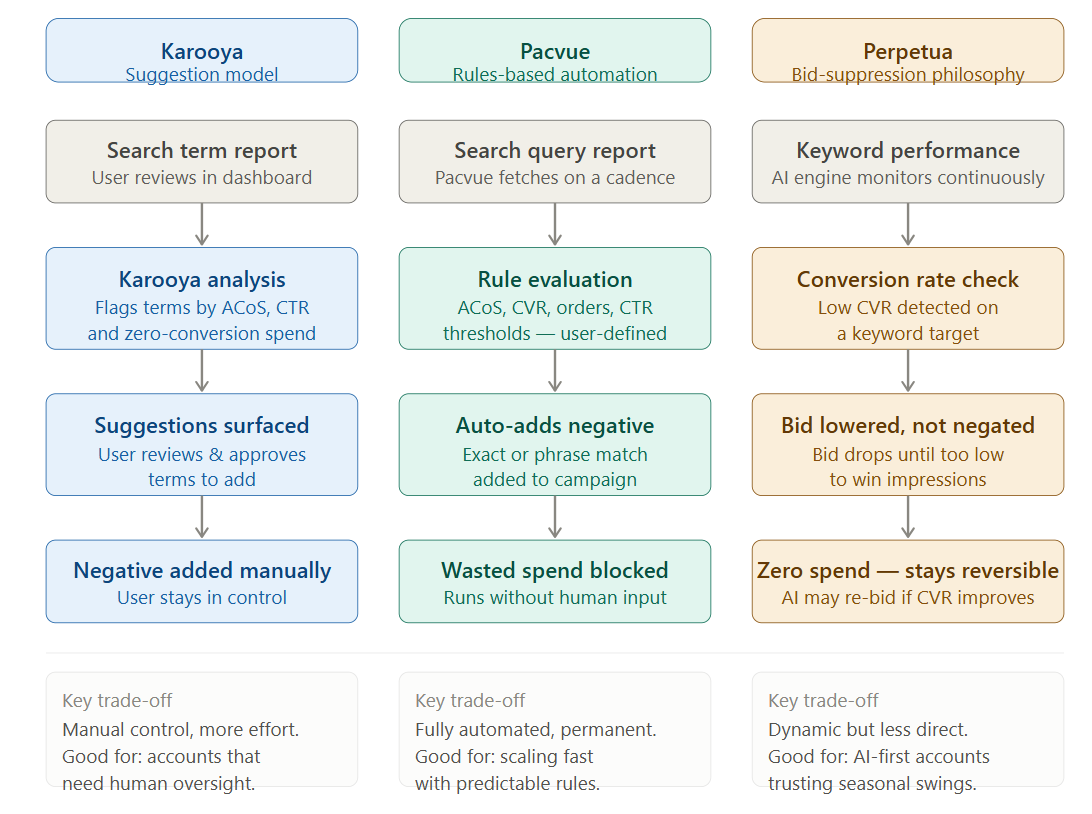
How Karooya Handles Negative Keywords
Karooya’s Amazon Ads offering centers around search-term analysis and negative keyword discovery.
The platform analyzes search query reports and identifies underperforming or irrelevant traffic patterns. Advertisers can review recommendations before implementation, helping maintain visibility into optimization decisions.
Publicly documented capabilities include:
- Search-term analysis
- Negative keyword recommendations
- Multi-word negative identification
- Shared negative keyword lists
- Negative product targeting recommendations
- Historical search-term analysis
Sources & Further Reading
- https://www.karooya.com/negative-keywords-for-amazon-ads
- https://www.karooya.com/blog/how-to-use-karooyas-negative-keywords-tool-for-amazon-ads/
- https://www.karooya.com/blog/types-of-negative-keywords-list-for-amazon-ads/
How Pacvue Handles Negative Keywords
Pacvue approaches negative keyword management through automation and workflow rules.
Public documentation shows advertisers can create campaign-level rules that analyze search query reports and automatically add negative keywords based on predefined performance conditions.
Negative keyword management is integrated into broader automation workflows that may also include:
- Bid management
- Budget management
- Retail intelligence signals
- Workflow automation
- Enterprise reporting
Sources & Further Reading
- https://pacvue.com/blog/key-to-success-in-conquering-negative-keywords/
- https://pacvue.com/blog/amazon-update-to-sponsored-brand-broad-match-keywords/
- https://pacvue.com/platform/advertising/
How Perpetua Handles Negative Keywords
Perpetua’s approach differs from both Karooya and Pacvue.
According to Perpetua’s Help Center, the platform’s optimization engine does not automatically add negative keywords. Instead, poor-performing keywords may be bid down until they effectively stop spending.
The rationale is that future changes in pricing, reviews, inventory, or seasonality may make a previously poor-performing keyword valuable again.
Manual negative keyword management remains fully supported.
Sources & Further Reading
- https://help.perpetua.io/en/articles/3396005-negative-keywords-in-perpetua
- https://perpetua.io/blog-amazon-advertising-ppc-automation/
- https://perpetua.io/amazon-advertising-software/
Negative Keywords Comparison
| Capability | Karooya | Pacvue | Perpetua |
| Search Term Analysis | Yes | Yes | Yes |
| Negative Keyword Recommendations | Yes | Automated through rules | Supported through optimization workflows |
| Shared Negative Lists | Yes | Not publicly documented | Not publicly documented |
| Multi-Word Negative Suggestions | Yes | Not publicly documented | Not publicly documented |
| Negative Product Target Recommendations | Yes | Supported | Manual management |
| Rule-Based Automation | Limited | Extensive | Moderate |
| AI-Driven Optimization | Limited | Moderate | Extensive |
| Search Query Visibility | High | Moderate | Moderate |
Key Takeaway
All three platforms help advertisers reduce wasted spend, but the optimization philosophy differs. Karooya emphasizes search-term analysis, Pacvue emphasizes automation rules, and Perpetua emphasizes AI-driven optimization.
Search Term Visibility & Historical Analysis
Why Search-Term Data Matters
Search-term data provides one of the clearest windows into shopper intent.
Understanding what shoppers searched before clicking an ad helps advertisers:
- Discover new keyword opportunities
- Identify negative keywords
- Improve product positioning
- Understand seasonality
- Monitor search behavior trends
- Improve campaign targeting
For many advertisers, search-term reports become the foundation for ongoing optimization.
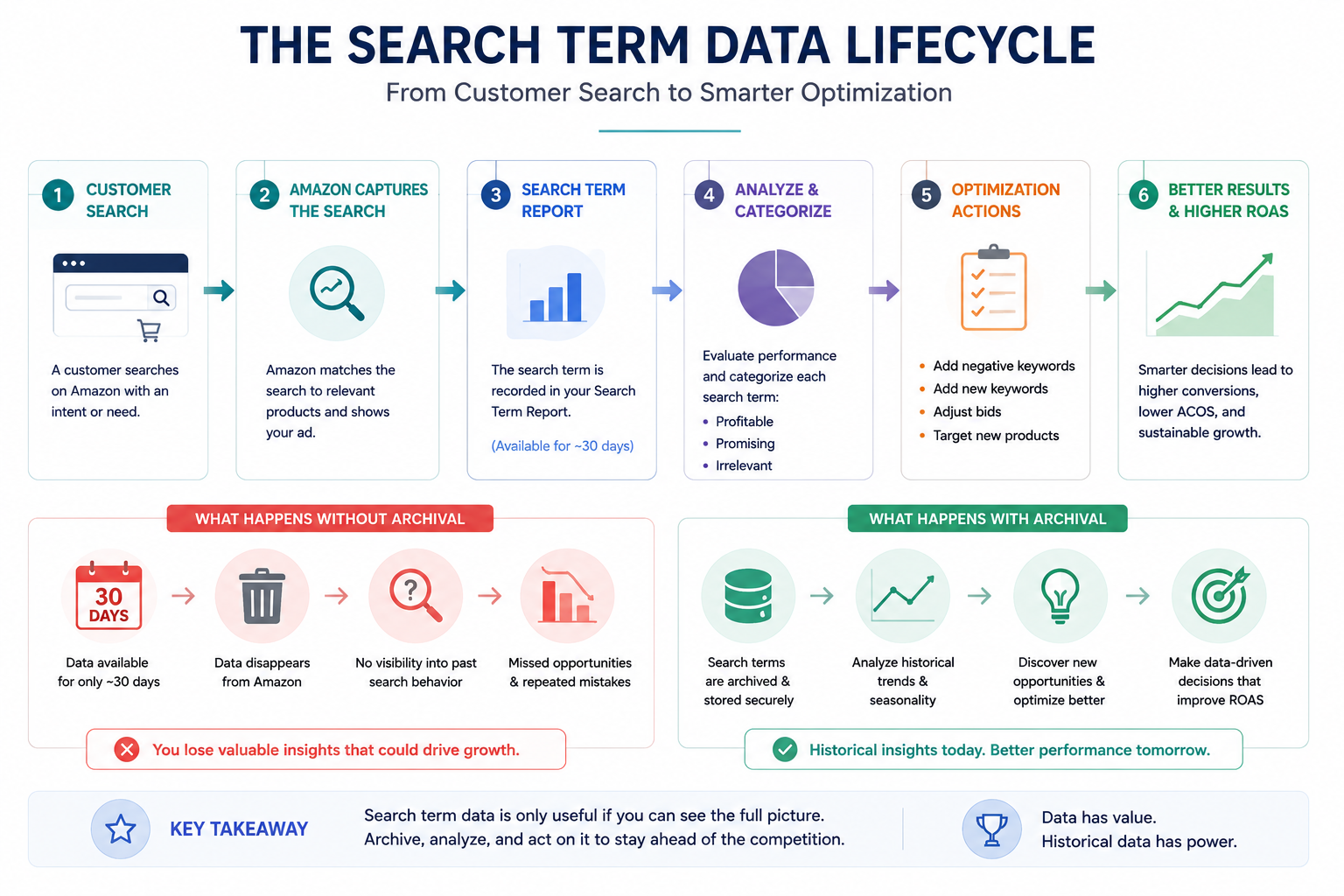
The challenge is retaining and analyzing that information over time.
How Karooya Handles Search-Term Visibility
Karooya offers a dedicated Search Term Archival capability designed to preserve historical search-term data.
The platform archives search-term information on an ongoing basis, allowing advertisers to review historical query performance and identify long-term trends.
Sources & Further Reading
- https://www.karooya.com/negative-keywords-for-amazon-ads
- https://www.karooya.com/blog/new-product-archive-your-search-terms-data-for-amazon-ads/
How Pacvue Handles Search-Term Visibility
Pacvue provides extensive reporting, analytics, and retail intelligence capabilities.
Search-term insights can be analyzed through dashboards, reporting environments, Amazon Marketing Cloud integrations, and enterprise reporting workflows.
However, public documentation does not position search term archival as a standalone feature.
Sources & Further Reading
- https://pacvue.com/marketplaces/pacvue-for-amazon/
- https://pacvue.com/platform/advertising/
- https://pacvue.com/platform/commerce/
How Perpetua Handles Search-Term Visibility
Perpetua provides search-query insights and historical performance reporting through Search Query Performance analysis, Search Insights, and optimization workflows.
Historical data supports keyword discovery and campaign optimization, although public documentation does not position search-term archival as a dedicated capability.
Sources & Further Reading
- https://perpetua.io/platform/
- https://help.perpetua.io/en/collections/2969810-amazon-advertising-perpetua-s-features
- https://perpetua.io/amazon-advertising-software/
Search Term Visibility Comparison
| Capability | Karooya | Pacvue | Perpetua |
| Search Term Reporting | Yes | Yes | Yes |
| Search Query Insights | Yes | Yes | Yes |
| Historical Performance Reporting | Yes | Yes | Yes |
| Search Term Trend Analysis | Yes | Yes | Yes |
| Dedicated Search Term Archival | Yes | Not publicly documented | Not publicly documented |
| Explicit Search-Term Preservation Feature | Yes | Not publicly documented | Not publicly documented |
Key Takeaway
All three platforms provide search-term reporting and insights. Based on publicly available information, Karooya is the only platform among the three that explicitly markets search-term archival as a dedicated capability.
Ad Scheduling
Why Timing Matters in Amazon Advertising
Not every hour performs equally.
Many advertisers discover that conversion rates vary significantly depending on:
- Time of day
- Day of week
- Seasonality
- Promotional periods
- Prime Day and major shopping events
As a result, campaign timing has become an important optimization lever.
Some platforms focus on scheduling controls. Others combine timing decisions with automation, AI, budget pacing, and performance signals.
How Karooya Handles Ad Scheduling
Karooya’s Ad Scheduler allows advertisers to automatically pause and resume campaigns according to predefined schedules.
The focus is on giving advertisers control over when campaigns run, helping reduce spend during periods that may not align with campaign goals.
Sources & Further Reading
- https://www.karooya.com/blog/new-feature-ad-scheduling-for-amazon-ads/
- https://www.karooya.com/negative-keywords-for-amazon-ads
How Pacvue Handles Ad Scheduling
Pacvue approaches scheduling through a broader dayparting and automation framework.
Publicly documented capabilities include:
- Dayparting
- Budget pacing
- Amazon Marketing Stream integration
- Automation rules
- Hourly performance analysis
Sources & Further Reading
- https://pacvue.com/tag/dayparting/
- https://pacvue.com/platform/advertising/
- https://pacvue.com/blog/pacvue-integrates-amazon-marketing-stream/
How Perpetua Handles Ad Scheduling
Perpetua incorporates campaign timing decisions into its AI-driven optimization framework.
Using Amazon Marketing Stream data and optimization tools, advertisers can analyze hourly performance and apply bid adjustments based on time-based patterns.
Public documentation references:
- Stream Reporting
- Stream Optimization
- Bid multiplier schedules
- Hourly performance insights
Sources & Further Reading
- https://perpetua.io/amazon-advertising-software/
- https://help.perpetua.io/en/articles/6337482-stream-reporting
- https://help.perpetua.io/en/articles/6337490-stream-optimization-bid-multiplier-schedules-dashboard
Ad Scheduling Comparison
| Capability | Karooya | Pacvue | Perpetua |
| Ad Scheduling | Yes | Yes | Yes |
| Campaign Enable/Pause Scheduling | Yes | Yes | Not publicly documented |
| Hourly Performance Analysis | Limited | Extensive | Extensive |
| Bid Multipliers by Time Period | No | Yes | Yes |
| Rule-Based Scheduling | Limited | Extensive | Moderate |
| AI-Driven Optimization | Limited | Moderate | Extensive |
| Budget Pacing Integration | Limited | Extensive | Strong |
| Amazon Marketing Stream Integration | No | Yes | Yes |
Key Takeaway
All three platforms help advertisers manage campaign timing, but their approaches differ. Karooya focuses on schedule-based campaign control.
Pacvue combines scheduling with dayparting, budget pacing, and retail intelligence. Perpetua integrates campaign timing into a broader AI-driven optimization framework powered by Amazon Marketing Stream data.
Frequently Asked Questions
What are negative keywords in Amazon Ads?
Negative keywords prevent ads from appearing for searches that are unlikely to generate profitable outcomes, helping reduce wasted spend and improve campaign efficiency.
Why is search-term analysis important?
Search-term analysis reveals the actual customer queries triggering ads, helping advertisers discover opportunities, improve targeting, and identify inefficient traffic.
What is search-term archival?
Search-term archival refers to preserving historical search-query data for future analysis beyond standard reporting windows.
Why does historical search-term data matter?
Historical data can reveal seasonal trends, recurring customer behavior, and long-term optimization opportunities that may not be visible in shorter reporting periods.
What is ad scheduling?
Ad scheduling allows advertisers to control when campaigns run. Depending on the platform, this may involve campaign activation schedules, automation rules, bid adjustments, or AI-driven optimization.
How do AI-driven advertising platforms use search-term data?
AI-driven platforms analyze search-term performance, conversion behavior, bidding signals, and campaign outcomes to automate optimization decisions.
Are negative keywords and bid optimization complementary?
Yes. Negative keywords help eliminate unwanted traffic, while bid optimization helps maximize efficiency across relevant traffic.
Final Thoughts
Karooya, Pacvue, and Perpetua all support Amazon advertisers, but they approach optimization from different perspectives.
Karooya focuses on search-term visibility, negative keyword discovery, historical search data, and advertiser-led optimization workflows.
Pacvue emphasizes enterprise automation, retail media management, reporting, and large-scale operational efficiency.
Perpetua focuses on AI-assisted optimization and reducing the amount of manual campaign management required.
For advertisers evaluating Amazon PPC software in 2026, the most important consideration may not be which platform has the longest feature list, but how each platform approaches optimization, decision-making, reporting, and advertiser control. Those differences often have a greater impact on day-to-day campaign management than any individual feature alone.
Note
This comparison has been prepared based on our understanding of each platform’s publicly available product documentation, help center articles, feature pages, blogs, release notes, and other official resources available as of June 2026.
As product capabilities continue to evolve, some features may have changed after publication or may not be fully reflected in publicly accessible documentation. Where a capability could not be verified through official sources, we have intentionally marked it as “Not publicly documented” rather than making assumptions.
If you represent Pacvue or Perpetua, or have access to additional official documentation that suggests any information in this comparison should be updated or clarified, we’d genuinely appreciate hearing from you. Our goal is to keep this article accurate, balanced, and useful for the Amazon advertising community, and we’ll gladly review and incorporate verified updates where appropriate.



Stop the wasted ad spend. Get more conversions from the same ad budget.
Our customers save over $16 Million per year on Google and Amazon Ads.